


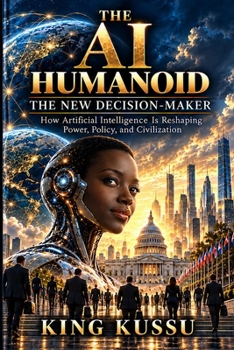
The AI Humanoid the New Decision-Maker: How Artificial Intelligence Is Reshaping Power, Policy, and Civilization

Who makes the decision when artificial intelligence begins shaping the choices before human beings ever see them?
Artificial intelligence is no longer simply a tool for faster calculation, better search, or automated assistance. It is becoming part of the architecture through which governments, corporations, markets, healthcare systems, security institutions, media platforms, and scientific organisations interpret reality, allocate resources, establish priorities, and act.
In THE AI HUMANOID: THE NEW DECISION-MAKER, KING KUSSU examines one of the defining questions of the twenty-first century: What happens to human authority when increasingly capable artificial intelligence begins to influence-and eventually execute-the decisions upon which institutions and civilisation depend?
The book introduces the concept of the algorithmic executive: an emerging computational layer that ranks information, predicts outcomes, frames options, recommends actions, and increasingly participates in execution before formal human authority reaches the final decision.
But the transformation does not end with software.
As artificial intelligence moves into humanoid robots and other embodied systems capable of perceiving, navigating, manipulating objects, interacting with people, and operating within physical environments, the boundary between recommendation and action becomes increasingly important.
Drawing on artificial intelligence, economics, history, philosophy, geopolitics, law, institutional governance, robotics, and documented real-world cases, KING KUSSU explores questions that leaders and societies can no longer afford to ignore:
- What happens when human decision-makers become dependent on systems they cannot fully inspect or independently challenge?
- Who remains accountable when authority is distributed across algorithms, corporations, institutions, and machines?
- How will AI reshape leadership, national power, strategic competition, labour, healthcare, justice, science, and public administration?
- What happens when intelligence acquires a physical body?
- Which decisions should never be delegated?
- And how can humanity benefit from extraordinary machine capability without surrendering meaningful control?
At the centre of the book is the Sovereign Intelligence Doctrine-a framework for preserving human authority in an increasingly computational civilisation.
Its governing principle is simple:
Execution may be computational. Sovereignty must remain human.
The book goes beyond diagnosis. It includes documented case studies and an Institutional Sovereignty Assessment Framework designed to help governments, companies, universities, hospitals, courts, financial institutions, researchers, and other organisations evaluate whether they remain meaningfully in control of the AI systems they deploy.
THE AI HUMANOID is not an argument against artificial intelligence. It is an argument for using it with ambition, intelligence, responsibility, and institutional discipline.
For policymakers, executives, academics, researchers, engineers, regulators, strategists, and anyone seeking to understand how artificial intelligence may reshape power, policy, leadership, and civilisation, this book asks the question that ultimately matters:
Will humanity merely build increasingly powerful intelligence-or remain capable of governing what it creates?
- KING KUSSUCustomer Reviews
ThriftBooks ® and the ThriftBooks ® logo are registered trademarks of Thrift Books Global, LLC
