
Skip to content
Scan a barcode
Scan
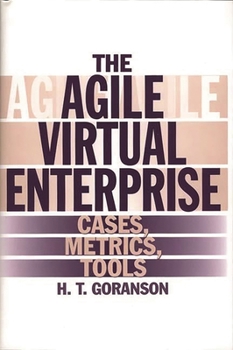
Hardcover The Agile Virtual Enterprise: Cases, Metrics, Tools Book

ISBN: 1567202640

ISBN13: 9781567202649

The Agile Virtual Enterprise: Cases, Metrics, Tools

Select Format

Select Condition ThriftBooks Help Icon

Recommended

Format: Hardcover

Condition: Very Good

$11.89
Save $83.11!
List Price $95.00
Almost Gone, Only 1 Left!

Book Overview

New ways to manage change and to compete in a rapidly changing business world are emerging under the concept of the agile enterprise. Agile organizations can be almost any size or type, but what distinguishes them from their lumbering traditional business counterparts is the ability to read and to react quickly. They can also be virtual, meaning they can reconfigure themselves quickly and temporarily in response to a challenge, which gives them agility, but then dissolve or transmute themselves into something else. Goranson explains how they do this and how your own organization can do it too. With fascinating case studies and a unique metric, Goranson provides answers. The result is essential reading for management at almost any level within every type of organization.

Now that serious management tools are beginning to appear, the agile virtual enterprise is no longer just a theoretical possibility--it's real. In fact, although they were never actually described that way, virtual organizations can be found throughout history, from the whaling companies of the 19th century through the film studios of the 20th. Goranson describes many of these businesses and gives us an understanding of how they evolved and why they worked. Of special interest is his metric. It requires no technical background to be understood and applied, yet it digs deeply into the philosophy of strategic management as well as its practicalities. Goranson also reports for the first time on the large scale research sponsored by the U.S. military to advance the state of the art in management science and to create the tools that eventually made the agile virtual enterprise what it is today.

Customer Reviews

5 ratings

The Definition of Agility

Although getting close to 20 years old now, The Agile Virtual Enterprise: Cases, Metrics, Tools, written in 1992 by H T (Ted) Goranson, is a book that still holds timeless ideas and visions that are still applicable. While the at that time emerging vision of the virtual enterprise is at the forefront of the book, it is also the only reference I have found that properly differentiates between agility and flexibility and what being agile actually entails. The reason why I came across this book in the first place was that I used i to fully understand the concept of virtual enterprises when I was preparing my book chapter in Managing Risk in Virtual Enterprise Networks: Implementing Supply Chain Principles. Prior to that I had only read Ken Thompson's The Networked Enterprise : Competing for the Future Through Virtual Enterprise Networks, another visionary book, but Ted Goranson's book was the one that truly opened my eyes to the virtues of the virtual enterprise. Goranson differentiates between agility and flexibility. Agility is the ability to respond to (and ideally benefit from) unexpected change. Agility is unplanned and unscheduled adaption to unforeseen and unexpected external circumstances. Flexibility is scheduled or planned adaptation to unforeseen yet expected external circumstances. Goranson sets out to define agility on the enterprise level, particularly the virtual enterprise level, where the virtual enterprise is an aggregation of indivdual enterprises, working together as one entity. Agility then, has an internal direction, within each enterprise and within the virtual enterprise as a whole, and agility as an external direction, from the virtual enterprise towards the external environment or business opportunities. The overall agility of the virtual enterprise (or supply chain, we could say) depends on both internal and external agility, and internal agility is a prerequisite for external agility. Unless you are able to rearrange your troops in the midst of a raging battle you cannot win on the changing battlegrounds that business often is. One of the foremost abilities of an agile enterprise is its ability to quickly react to change and adapt to new opportunities. This ability to change works along two dimensions: 1) the number or "types of change" an organization is able to undergo and 2) the "degree of change" an organization is able to undergo. The former Goranson calls "scope", the latter he calls "robustness". The more robust an enterprise is, the more radical a change it can gracefully address. "Scope refers to how large a domain is covered by the agile response system, in other words, how far from the expected set of events one can go and still have the system respond well. Robustness is a measure of how well the system responds, given a specific scope." I my opinion, this definition truly captures the essence of agility. Admittedly, this book is not new. But I think it deserves to be mentioned, time and again.

6 years later - still valuable and fresh

Goranson presents a clear and compelling case for the value of agility in the enterprise, complete with easily understood historical case studies. Unlike so many other works, he does not confuse 'agility' with speed, lean-ness, or the ability to cope with expected change, as do so many other authors writing about agility. My one disappointment is the Tools section, which is most theories and algorithms, rather than reports on and references to software tools available in the marketplace. Given this work was published in 1999, I suspect this is because there were not tools for agility widely available- and not at all the author's shortcoming. It would great to see an update to this section, if in fact there are now tools that have been designed as "agility tools."

This book deals with a topic at the core of agility

Since 1994, at least nine books have been published dealing with the topic of agility or agile manufacturing. The first book, published in 1994 was my own, Agile Manufacturing: Forging New Frontiers (Addison-Wesley). The ninth, published in 1999, entitled The Agile Virtual Enterprise: Cases, Metrics and Tools (Quorum Books) is by Ted Goranson. I have all nine on my bookshelf and I have read them all! Books two through to eight (I won't mention them by name) all have one common specific feature - they are largely unrelated to each other. They are also not much related to the topic of agility either, but that's another story. Moreover, books two to eight are not much related to books one or nine. In fact there is a massive gap, nay gulf! However there is a common thread between the first and the ninth book.In Agile Manufacturing: Forging New Frontiers I insisted (and I still do) that there were no agile firms. Also I was keen to point out that the notion that one could figure things out in advance and then design a strategy or an enterprise configuration based on this specification was, dead in the water. This approach simply does not work well when one is faced with significant change and uncertainty. In this kind of environment a whole new approach is needed. Ted Goranson's book makes a significant contribution to the development of this new way of working.To be found in Ted's book are accounts of the development of virtual enterprise from the days of whaling and the importance of trust, lightweight agreements and case law in supporting the formation of agile virtual enterprises. Also to be found are discussions on what agility is and what agility is not, and why agility is important, along with comments about how agility relates to flexibility, electronic commerce and lean production. There is a detailed Agile Virtual Enterprise Reference Model and also descriptions of some agile virtual enterprise practices based on a number of case studies. From these case studies comes confirmation that agility tends to be isolated within specific parts of a firm and is often fortuitous and unplanned. These agile practices are not institutionalised and are not part of some grand agility strategy.The book makes an important contribution to measuring agility. There is a detailed description of a modelling technique, based on communicative acts, that allows one to generate simple metrics that one can use to establish and compare the agility of different candidate processes that form part of the Agile Virtual Enterprise Reference Model. This is a novel and useful development.This book contains a lot of substantial material and is very stimulating. The only minor point of criticism is that the description of flexibility does not make use of the frameworks and literature on that subject. I believe this would have helped to improve the positioning of agility in relation to flexibility. However, the theory of agility is still ver

Excellent Reference for Research and Industry

This book offers a impressive review and explanation of agility and virtualness, describing through the examples how these both concepts influenced our past, present and future.I am personally using it as a reference for establishing in Brazil a Virtual Organization as well as for my under and post-graduation courses.I highly recommend this book for people who really intend and need a strong basys for working with agility and virtualness.Congratulations for Ted Goranson for this excellent work.

Finally a book adding flesh to the concept of Agility

Agility is a term that is ventilated for a long time in the academic and some business community. However, so far the question remains broadly unanswered on what it really is about and what difference Agility makes.This book makes a difference, saying that agility is about managing dynamic change and what consequences this has for the entire company management.Ted Goranson does a great job in giving the reader strong pictures and cases about Agility first. But he does not simply stay with some (war-)story telling. Instead he ventures to develop general concepts and models with scientific rigour. Linking his models to existing mainstream theories and some innovative developments allows him to show, what agility is - and what it is not. And it allows him to trace the consequences of becoming agile into such distinct management functions as corporate finance, human resource management, manufacturing and innovation or information systems.A book invaluable for all, who plan to apply the concept of agility and even more for those who develop methods, tools and system to support agile enterprises.
Copyright © 2025 Thriftbooks.com Terms of Use | Privacy Policy | Do Not Sell/Share My Personal Information | Cookie Policy | Cookie Preferences | Accessibility Statement
ThriftBooks ® and the ThriftBooks ® logo are registered trademarks of Thrift Books Global, LLC

GoDaddy Verified and Secured