


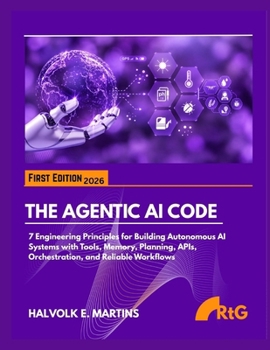
The Agentic AI Code: 7 Engineering Principles for Building Autonomous AI Systems with Tools, Memory, Planning, APIs, Orchestration, and Reliable Workf
No Customer Reviews

THE AGENTIC AI CODE 7 Engineering Principles for Building Autonomous AI Systems with Tools, Memory, Planning, APIs, Orchestration, and Reliable Workflows Your AI can generate impressive answers-but what happens when you ask it to do something instead of simply tell you how to do it? It needs to choose the right tool. Remember what happened earlier. Break a complex objective into steps. Work with APIs and external systems. Recover when something fails. Decide when it needs more information. Know when to stop. And, most importantly, operate within boundaries you can actually trust. That is where building agentic AI becomes much harder than writing a clever prompt. The Agentic AI Code takes you inside the engineering principles behind autonomous AI systems and shows you how the pieces fit together as a complete architecture. Rather than treating AI agents as mysterious black boxes, this book breaks them down into understandable engineering components. You will learn how goals, state, context, memory, tools, planning, APIs, orchestration, guardrails, testing, and observability work together to create systems capable of performing multi-step tasks. Inside, you will explore: - How AI assistants evolve into autonomous systems capable of taking meaningful actions.
- The anatomy of an AI agent and the decision loops that drive its behavior.
- How to give agents tools without giving them uncontrolled authority.
- How agents select, invoke, validate, and recover from tool operations.
- How short-term, long-term, and working memory influence agent behavior.
- How to manage context so agents can retrieve useful information without overwhelming their decision process.
- How to decompose complex objectives into practical plans and adapt when those plans fail.
- How APIs and structured interfaces allow agents to interact reliably with external systems.
- How authentication, permissions, and access boundaries affect agent security.
- How orchestration coordinates sequential, parallel, conditional, and multi-agent workflows.
- How specialized agents can collaborate through controlled handoffs and shared state.
- How observability and tracing reveal what an autonomous system is actually doing.
- How to test failure scenarios instead of testing only the happy path.
- How guardrails, recovery strategies, and human oversight keep autonomy within defined limits.
- How to move an agentic system from an impressive prototype toward production readiness. The book focuses on engineering decisions, not hype. You will learn to think about agentic AI as a system rather than a single model: a system with inputs, state, decisions, tools, dependencies, actions, failures, recovery paths, and measurable outcomes. Whether you are exploring AI agents for the first time or already building applications that connect models to tools and services, this book gives you a structured foundation for understanding what happens beneath the surface. Because the difficult part of agentic AI is not simply making an agent act. The difficult part is making it act reliably. If you want to understand how autonomous AI systems are architected, controlled, connected, tested, and prepared for real-world use, The Agentic AI Code gives you the engineering principles to start building with a clearer perspective. Open the book, study and understand the architecture, and start thinking beyond the prompt.
Format:Paperback
Language:English
ISBN:B0HK34LWHN
ISBN13:9798174979857
Release Date:September 2026
Publisher:Independently Published
Length:152 Pages
Weight:0.81 lbs.
Dimensions:0.3" x 8.5" x 11.0"
Customer Reviews
0 rating
Copyright © 2026 Thriftbooks.com
Terms of Use | Privacy Policy | Do Not Sell/Share My Personal Information | Cookie Notice | Cookie Preferences | Accessibility Statement
ThriftBooks ® and the ThriftBooks ® logo are registered trademarks of Thrift Books Global, LLC
ThriftBooks ® and the ThriftBooks ® logo are registered trademarks of Thrift Books Global, LLC
