


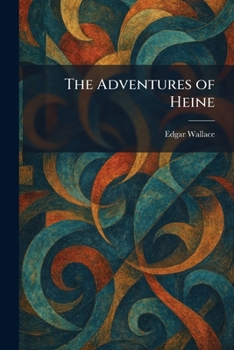
The Adventures of Heine

Select Format
Select Condition 
Book Overview
"The Adventures of Heine" is a fast-paced and suspenseful collection of espionage stories written by the legendary Edgar Wallace. Set during the height of the First World War, the book follows the daring and often precarious exploits of Heine, a resourceful secret agent operating behind enemy lines in England. Unlike many thrillers of its time, this work offers a unique perspective on the intelligence games played during the Great War, blending Wallace's signature wit with high-stakes tension.
The narrative is composed of a series of episodic encounters where Heine must navigate a world of double-crosses, hidden identities, and the constant threat of capture. Wallace masterfully evokes the atmospheric tension of wartime London, portraying the intricate methods used by operatives to gather information and evade the authorities. As one of the most prolific voices in early twentieth-century crime fiction, Wallace delivers a narrative that is both a historical curiosity and an engaging thriller. "The Adventures of Heine" stands as an essential read for fans of classic spy fiction, showcasing the evolution of the genre and the enduring appeal of the master of the modern thriller.
This work has been selected by scholars as being culturally important, and is part of the knowledge base of civilization as we know it. This work was reproduced from the original artifact, and remains as true to the original work as possible. Therefore, you may see the original copyright references, library stamps (as most of these works have been housed in our most important libraries around the world), and other notations in the work.
This work is in the public domain in the United States of America, and possibly other nations. Within the United States, you may freely copy and distribute this work, as no entity (individual or corporate) has a copyright on the body of the work.
As a reproduction of a historical artifact, this work may contain missing or blurred pages, poor pictures, errant marks, etc. Scholars believe, and we concur, that this work is important enough to be preserved, reproduced, and made generally available to the public. We appreciate your support of the preservation process, and thank you for being an important part of keeping this knowledge alive and relevant.
Customer Reviews
ThriftBooks ® and the ThriftBooks ® logo are registered trademarks of Thrift Books Global, LLC
