


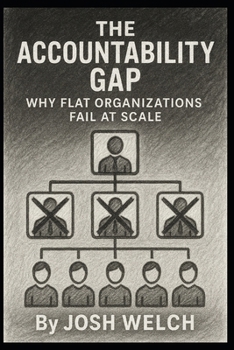
The Accountability Gap: Why Flat Organizations Fail at Scale

When everyone is accountable, no one is accountable.
Sarah Brennan was the DevOps Manager who kept GlobalTech running. For eight years, she built the systems, developed the talent, and solved the problems that executives never saw. Then leadership decided to "flatten" the organization and eliminate management layers to preserve their startup culture.
They called it empowerment. Sarah called it chaos.
Within eighteen months, the company lost its best engineers, botched its most critical product launch, and destroyed decades of institutional knowledge-all while leadership insisted the "culture" was stronger than ever. Sarah documented every warning sign. She proposed solutions. She fought for her team.
They fired her anyway.
The Accountability Gap is a business fable about the most common-and most ignored-failure mode in growing companies: the refusal to scale organizational structure alongside business growth. Through Sarah's story at GlobalTech, you'll witness how flat organizations that work brilliantly at 50 people collapse catastrophically at 500.
Part One tells the story of GlobalTech's descent from industry leader to cautionary tale-the warning signs leadership missed, the dysfunction that metastasized, and the human cost of organizational ideology over operational reality.
Part Two follows Rachel Kim, the new CTO brought in to rebuild, as she investigates what went wrong. Her findings reveal a systematic framework for understanding when and how organizations must evolve their structure, including:
Why "flat" is a stage, not a destinationThe five critical functions that middle managers perform (that don't disappear when you eliminate the role)The mathematical reality of coordination at scaleHow to recognize the signals that your organization has outgrown its structureWhat healthy scaling actually looks likeThis book is for:
Executives navigating growth transitionsMiddle managers caught between strategy and executionHR and People leaders designing organizational structureFounders wondering when to add management layersAnyone who has watched a company destroy itself by clinging to startup culture past its expiration dateThe companies that thrive long-term aren't the ones that resist hierarchy-they're the ones that evolve it thoughtfully. The Accountability Gap shows you how to recognize when your organization needs to change, what happens when you don't, and how to build structure that enables rather than constrains.
Book One of The Scaling Timing Series
Customer Reviews
ThriftBooks ® and the ThriftBooks ® logo are registered trademarks of Thrift Books Global, LLC
