


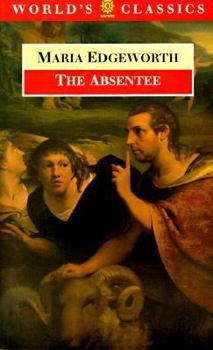
The Absentee (The ^AWorld's Classics)


Select Format
Select Condition 
Book Overview
Lord Clonbrony and his ambitious, worldy wife lead an extravagant social life in London on the proceeds of their estates in Ireland. Their son, Lord Colambre, refusing to marry the heiress arranged for him by his mother, decides instead to investigate, incognito, the management of the family estates in Ireland. Appalled by the corruption, mismanagement, and poverty he discovers, he sets about finding a solution to his father's debts and the family's wilful indifference. Maria Edgeworth's classic novel combines a fast-miving depiction of national manners with a brilliantly witty expose of the pernicious system of absentee landownership.
Format:Paperback
Language:English
ISBN:0192816829
ISBN13:9780192816825
Release Date:December 1988
Publisher:Oxford University Press
Length:368 Pages
Weight:0.66 lbs.
Dimensions:7.3" x 0.7" x 4.6"
Customer Reviews
2 ratings
Anglo-Irish Look at Ireland
Published by Thriftbooks.com User , 20 years ago
Too often remembered solely as a British author, Maria Edgeworth's "The Absentee" provides a wonderful depiction of Ireland during the height of England's attempts to colonize Ireland through plantations. The historical problem with these estates was the often absence of the Lord. Edgeworth's novel reveals her Anglo-Irish stature. It depicts the Irish as either primitive and lacking ethics or as child-like and pure. Both of these reflect England's propaganda that was paired with the attempts at colonization. Edgeworth's style reminds me very much of Jane Austen in that she focuses on the manners of the characters. In many ways, the characters resemble Austen's. The way Edgeworth depicts the individuals of Ireland, the way she represents the different class distinctions through the use of syntax and accents is deft. Edgeworth's novel is an invaluable tool for experiencing Ireland during its period of colonization. It combines the political, religious and economic aspects of Ireland. "The Absentee" demands an understanding of Irish history. It is a superb novel and highly enriching for anyone seeking a greater knowledge of Ireland.
The Prominent Son
Published by Thriftbooks.com User , 23 years ago
Duty, Loyalty, and Honor is the foremost part on his mind for our hero, Lord Colambre. To resolve his parents financial troubles and follies in London, he venture back to his homeland, Ireland, in disguise to investigate the agents who are governing his father's estate. Witnessing the corruption but also the beauty, he determine to bring those corrupter to justice and hope to stay in Ireland. And of course, there is a romance, but as you all know the hero always get his girl.
Copyright © 2026 Thriftbooks.com
Terms of Use | Privacy Policy | Do Not Sell/Share My Personal Information | Cookie Notice | Cookie Preferences | Accessibility Statement
ThriftBooks ® and the ThriftBooks ® logo are registered trademarks of Thrift Books Global, LLC
ThriftBooks ® and the ThriftBooks ® logo are registered trademarks of Thrift Books Global, LLC
