


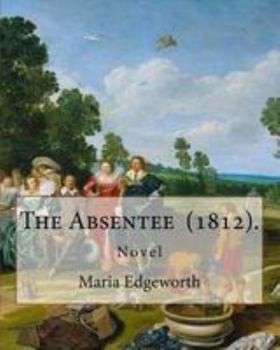
The Absentee (1812). By: Maria Edgeworth, NOVEL: Maria Edgeworth (1 January 1768 - 22 May 1849) was a prolific Anglo-Irish writer of adults' an


Select Format
Select Condition 
Book Overview
Lord Colambre, the sensitive hero of the novel, finds that his mother Lady Clonbrony's attempts to buy her way into the high society of London are only ridiculed, while his father, Lord Clonbrony, is in serious debt as a result of his wife's lifestyle. Colambre travels incognito to Ireland to see the country that he still considers his home. When he returns to London he assists his father to pay off the debts, on condition that the Clonbrony family return to live in Ireland.,,, Maria Edgeworth (1 January 1768 - 22 May 1849) was a prolific Anglo-Irish writer of adults' and children's literature. She was one of the first realist writers in children's literature and was a significant figure in the evolution of the novel in Europe. She held advanced views, for a woman of her time, on estate management, politics and education, and corresponded with some of the leading literary and economic writers, including Sir Walter Scott and David Ricardo. Early life: Maria Edgeworth was born at Black Bourton, Oxfordshire. She was the second child of Richard Lovell Edgeworth (who eventually fathered 22 children by four wives) and Anna Maria Edgeworth; Maria was thus an aunt of Francis Ysidro Edgeworth. She spent her early years with her mother's family in England, until her mother's death when Maria was five. When her father married his second wife Honora Sneyd in 1773, she went with him to his estate, Edgeworthstown, in County Longford, Ireland. Maria was sent to Mrs. Lattafi re's school in Derby after Honora fell ill in 1775. After Honora died in 1780 Maria's father married Honora's sister Elizabeth (then socially disapproved and legally forbidden from 1833 until the Deceased Wife's Sister's Marriage Act 1907). Maria transferred to Mrs. Devis's school in London. Her father's attention became fully focused on her in 1781 when she nearly lost her sight to an eye infection. Returning home at the age of 14, she took charge of her many younger siblings and was home-tutored in law, Irish economics and politics, science, and literature by her father. She also started her lifelong correspondences with learned men, mainly members of the Lunar Society. She became her father's assistant in managing the Edgeworthstown estate, which had become run-down during the family's 1777-1782 absence; she would live and write there for the rest of her life. With their bond strengthened, Maria and her father began a lifelong academic collaboration "of which she was the more able and nimble mind." Present at Edgeworthstown was an extended family, servants and tenants. She observed and recorded the details of daily Irish life, later drawing on this experience for her novels about the Irish. She also mixed with the Anglo-Irish gentry, particularly Kitty Pakenham (later the wife of Arthur Wellesley, 1st Duke of Wellington), Lady Moira, and her aunt Margaret Ruxton of Black Castle. Margaret supplied her with the novels of Anne Radcliffe and William Godwin and encouraged her in her writing. Though Maria Edgeworth spent most of her childhood in England, her life in Ireland had a profound impact on both her thinking and views surrounding her Irish culture. Fauske and Kaufman conclude, " She] used her fiction to address the inherent problems of acts delineated by religious, national, racial, class based, sexual, and gendered identities." Edgeworth used works such Castle Rackrent and Harrington to express her feelings on controversial issues............
Format:Paperback
Language:English
ISBN:197650984X
ISBN13:9781976509841
Release Date:September 2017
Publisher:Createspace Independent Publishing Platform
Length:168 Pages
Weight:0.88 lbs.
Dimensions:0.4" x 8.0" x 10.0"
Customer Reviews
2 ratings
Anglo-Irish Look at Ireland
Published by Thriftbooks.com User , 20 years ago
Too often remembered solely as a British author, Maria Edgeworth's "The Absentee" provides a wonderful depiction of Ireland during the height of England's attempts to colonize Ireland through plantations. The historical problem with these estates was the often absence of the Lord. Edgeworth's novel reveals her Anglo-Irish stature. It depicts the Irish as either primitive and lacking ethics or as child-like and pure. Both of these reflect England's propaganda that was paired with the attempts at colonization. Edgeworth's style reminds me very much of Jane Austen in that she focuses on the manners of the characters. In many ways, the characters resemble Austen's. The way Edgeworth depicts the individuals of Ireland, the way she represents the different class distinctions through the use of syntax and accents is deft. Edgeworth's novel is an invaluable tool for experiencing Ireland during its period of colonization. It combines the political, religious and economic aspects of Ireland. "The Absentee" demands an understanding of Irish history. It is a superb novel and highly enriching for anyone seeking a greater knowledge of Ireland.
The Prominent Son
Published by Thriftbooks.com User , 22 years ago
Duty, Loyalty, and Honor is the foremost part on his mind for our hero, Lord Colambre. To resolve his parents financial troubles and follies in London, he venture back to his homeland, Ireland, in disguise to investigate the agents who are governing his father's estate. Witnessing the corruption but also the beauty, he determine to bring those corrupter to justice and hope to stay in Ireland. And of course, there is a romance, but as you all know the hero always get his girl.
Copyright © 2026 Thriftbooks.com
Terms of Use | Privacy Policy | Do Not Sell/Share My Personal Information | Cookie Policy | Cookie Preferences | Accessibility Statement
ThriftBooks ® and the ThriftBooks ® logo are registered trademarks of Thrift Books Global, LLC
ThriftBooks ® and the ThriftBooks ® logo are registered trademarks of Thrift Books Global, LLC
