


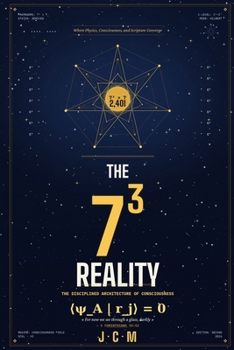
The 73 Reality: Where Physics, Consciousness, and Scripture Converge

What is consciousness actually made of?
Not what it looks like.
Not what it feels like.
Not what it depends on.
What is its structure?
For decades, the Hard Problem of consciousness has resisted every serious attempt at reduction. Physics can describe measurement with extraordinary precision, yet still cannot say what the observer is. Philosophy can analyze experience, yet still cannot explain why experience exists at all.
The 73 Reality proposes that both failures arise from the same mistake:
we have been using the wrong reference frame.
In this second edition, J.C. Medina presents a disciplined framework in which consciousness is modeled as structured rather than vague, and fundamental rather than derivative. At the center of that framework is a 2,401-state architecture: 2,370 carrier-assignable modes and 31 irreducible relational modes that are formally inaccessible from any isolated single-carrier frame. In that model, the Hard Problem is not simply unsolved. It is mislocated.
This is not a book of loose mysticism or decorative mathematics. It is a rebuilt exposition - one that openly distinguishes what is derived, what is motivated, what is predicted, and what remains interpretive. Layer 1 mathematical structure stands first. Layer 2 theological reading follows visibly and never substitutes for the formal work. That discipline is part of the book's core identity.
Inside this book: a 2,401-dimensional consciousness architecture built from 73 7the formal decomposition of consciousness into individual and relational sectorsthe orthogonality identity that reframes the Hard Problem from inside the modela 7-level frequency ladder anchored at 7.83 Hzthe 144,060 grace margin as a structural tolerance parameterexplicit falsification targets, open frontiers, and a disciplined epistemic frameworkA rebuilt second editionThis edition does not merely revise the first. It hardens it.
Where the earlier version asserted, this edition derives.
Where the earlier version mixed registers, this edition separates them.
Where earlier formulations overreached, this edition marks boundaries, names open problems, and invites evaluation rather than demanding assent.
No date-setting.
No vague New Age language.
No demand that theological interpretation replace mathematics.
No demand that mathematics replace Scripture.
This book is a serious framework proposal at the meeting point of consciousness studies, philosophy of physics, and theological structure.
A single empirical anchor. A tightly constrained architecture. A framework that now stands or falls by measurement.
Customer Reviews
ThriftBooks ® and the ThriftBooks ® logo are registered trademarks of Thrift Books Global, LLC
