


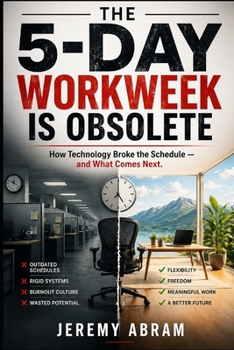
The 5-Day Workweek Is Obsolete: How Technology Broke the Schedule - and What Comes Next

For more than a century, the five-day, forty-hour workweek has shaped modern life.
It determines when we wake up, when we commute, when businesses open, and when society rests.
But the world that created this system no longer exists.
Factories once required synchronized labor.
Offices required physical presence.
Communication moved slowly.
Today, technology has changed everything.
Work happens on laptops, smartphones, and cloud platforms.
Teams collaborate across continents.
Artificial intelligence accelerates tasks that once took hours.
Yet the structure of work has barely changed.
Why?
In The 5-Day Workweek Is Obsolete, Jeremy Abram explores the hidden history of the modern work schedule-and the growing evidence that it may no longer fit the digital age.
This thought-provoking book examines:
- How the five-day workweek was originally designed for factories
- Why modern office culture copied a system built for machines
- The science of focus, attention, and human productivity
- The rise of productivity theater in modern workplaces
- What the remote work experiment revealed during the global pandemic
- The growing movement toward four-day workweeks and flexible schedules
- How artificial intelligence may reshape the future of working time
- Practical ways individuals and organizations can rethink how work is structured
Through research, observation, and real-world examples, Abram challenges one of the most deeply ingrained assumptions in modern life:
That productivity must follow the same schedule it did a hundred years ago.
This book is not about working less.
It is about working smarter.
Because if technology has transformed nearly every other part of life, it may finally be time to ask whether the workweek itself should evolve.
Customer Reviews
ThriftBooks ® and the ThriftBooks ® logo are registered trademarks of Thrift Books Global, LLC
