


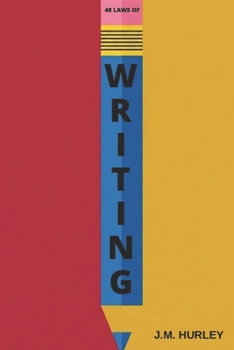
The 48 Laws of Writing
No Customer Reviews

Most novels fail. Not for lack of talent. They fail because the writer was breaking laws they could not name. In The 48 Laws of Writing, J.M. Hurley distills the unspoken disciplines that govern every successful work of fiction, journalism, and memoir into forty-eight precise principles. Drawing on the careers of Trollope, Joyce, Roth, Didion, Le Carr , Munro, Hemingway, Highsmith, Capote, and dozens more (both the masters who endured and the once-celebrated who vanished), these laws are not encouragement. They are diagnosis. Each law names a specific failure mode and the discipline that defeats it. What Tolstoy understood about endings that Hardy understood about executions. How Patricia Highsmith made the reader love a murderer. What Hemingway stole from the King James Bible that Dos Passos could not steal from anyone. Why Trollope, prolific to a fault, watched his reputation collapse before his death. How Joe McGinniss, Janet Malcolm, and Truman Capote each tested the limits of what a writer can take from a subject. Why the writer who refuses every dinner has no career, and the writer who attends every dinner has no book. The laws cover voice, structure, character, dialogue, fear, comedy, persona, originality, the management of a career, the danger of feuds, the necessity of revision, and the discipline of refusing the wrong publishing deal. Each law is presented as a Judgment, a Transgression of the law and what happened to its transgressor, an Observance and what came of it, Keys to Writing the principle, and a Reversal that names when the law itself should be broken. A craft book without comfort. A career book without flattery. The book for writers who intend to be read.
Format:Paperback
Language:English
ISBN:B0GYNHPB36
ISBN13:9798258933928
Release Date:April 2026
Publisher:Independently Published
Length:280 Pages
Weight:0.83 lbs.
Dimensions:0.6" x 6.0" x 9.0"
Customer Reviews
0 rating
Copyright © 2026 Thriftbooks.com
Terms of Use | Privacy Policy | Do Not Sell/Share My Personal Information | Cookie Notice | Cookie Preferences | Accessibility Statement
ThriftBooks ® and the ThriftBooks ® logo are registered trademarks of Thrift Books Global, LLC
ThriftBooks ® and the ThriftBooks ® logo are registered trademarks of Thrift Books Global, LLC
