


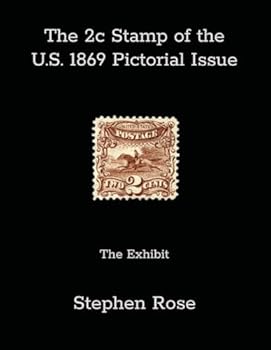
The 2c Stamp of the U.S. 1869 Pictorial Issue: The Exhibit
No Customer Reviews

The exhibitor, Stephen Rose, said Why did I specialize in the 2-cent 1869 stamp? After several decades of being a general U.S. collector, I gradually developed an irresistible itch to collect one stamp from the 1869 Pictorial issue - in depth. But which one? The 15-90¢ bi-colors were too expensive - leave them to the millionaires. The 6¢ and 12¢ were geared mainly to the British rate structure, with little domestic use. Michael Laurence has a life-lock on the 10¢ Pictorial, having already developed a specialty collection while I was still receiving H.E. Harris approvals for my worldwide Statesman album. Similarly, it would be hard to top the magnificent 10-frame exhibit of the 3¢ stamp prepared by Rex Stever in the 1990s. The 1¢ denomination had a relatively narrow usage, and the famous Waterbury running chicken cover would always hang like an unaffordable shadow over any collection I could assemble of this stamp. So, this left the 2¢ by default as a viable candidate. The 2¢ Pictorial is indeed the "junk mail" stamp of its era - a primary workhorse for all domestic mail except for first-class letters. As one might expect, most of the 2nd and 3rd class mail - involving wrappers, newspapers, pamphlets, circulars, seed packets, and what the Post Office Department labeled as "miscellaneous matter" - was discarded. Examples of certain 2nd and 3rd class uses are exceptionally hard to find, often limited to five or fewer known pieces. These remnants were often roughly treated by their original recipients and subsequently not prized by collectors, until lately when their relative scarcity has been better understood. Such domestic uses of the 2¢ stamp are often overshadowed by the more popular and sought-after covers to international destinations. The range of rates and routes for international mail during 1869-70 is exceptionally broad. The 2¢ Pictorial became an essential stamp on many international covers because the printed matter, first-class, and registered rates to other nations were often listed in even-number increments. It became the little brown dog that went all around the philatelic neighborhood. The lack of a 4¢ Pictorial denomination amplified this reliance on the 2¢ stamp. This is the full-color reproduction of the finest exhibit of this stamp ever prepared. It's marvelous. Another outstanding exhibit from Exhibitors Press.
Format:Paperback
Language:English
ISBN:B0CPCZQMJS
ISBN13:9798861449489
Release Date:December 2023
Publisher:Independently published
Length:103 Pages
Weight:0.73 lbs.
Dimensions:11.0" x 0.3" x 8.5"
Customer Reviews
0 rating
Copyright © 2026 Thriftbooks.com Terms of Use
| Privacy Policy | Do Not
Sell/Share My Personal Information | Cookie Policy | Cookie Preferences | Accessibility Statement
ThriftBooks® and the ThriftBooks® logo are registered trademarks of Thrift Books Global, LLC
ThriftBooks® and the ThriftBooks® logo are registered trademarks of Thrift Books Global, LLC
