


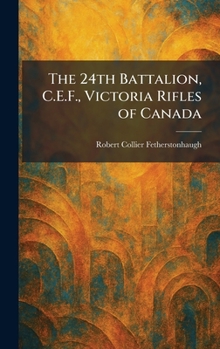
The 24th Battalion, C.E.F., Victoria Rifles of Canada

"The 24th Battalion, C.E.F., Victoria Rifles of Canada, 1914-1919" provides a comprehensive and authoritative account of one of Canada's most distinguished infantry units during the Great War. Written by noted military historian R. C. Fetherstonhaugh, this work meticulously chronicles the battalion's journey from its mobilization in Montreal to the battlefields of Europe. Readers are offered a detailed narrative of the unit's participation in major engagements on the Western Front, including the grueling struggles at Ypres, the Somme, Vimy Ridge, and Passchendaele.
This regimental history captures the tactical realities of trench warfare while honoring the individual and collective sacrifices of the men who served under the Victoria Rifles banner. Beyond tactical maneuvers, the work documents the daily life, spirit, and resilience of the soldiers within the Canadian Expeditionary Force. As a significant record of Canada's military contribution to World War I, this volume serves as an essential resource for historians, genealogists, and anyone interested in the valor and legacy of the Canadian military experience during the early 20th century.
This work has been selected by scholars as being culturally important, and is part of the knowledge base of civilization as we know it. This work was reproduced from the original artifact, and remains as true to the original work as possible. Therefore, you may see the original copyright references, library stamps (as most of these works have been housed in our most important libraries around the world), and other notations in the work.
This work is in the public domain in the United States of America, and possibly other nations. Within the United States, you may freely copy and distribute this work, as no entity (individual or corporate) has a copyright on the body of the work.
As a reproduction of a historical artifact, this work may contain missing or blurred pages, poor pictures, errant marks, etc. Scholars believe, and we concur, that this work is important enough to be preserved, reproduced, and made generally available to the public. We appreciate your support of the preservation process, and thank you for being an important part of keeping this knowledge alive and relevant.
Related Subjects
HistoryCustomer Reviews
ThriftBooks ® and the ThriftBooks ® logo are registered trademarks of Thrift Books Global, LLC
