


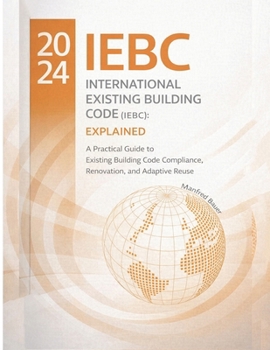
The 2024 International Existing Building Code (IEBC): Explained: A Practical Guide to Existing Building Code Compliance, Renovation, and Adaptive Reus

Most buildings we work on today are not new.
They come with structure already in place, systems layered over time, missing drawings, and decisions made under previous codes. The question is no longer how to build from scratch, but how to work with what already exists-safely, intelligently, and without unnecessary demolition.
The 2024 International Existing Building Code (IEBC) provides the framework for doing exactly that. Yet for many practitioners, it remains difficult to navigate: multiple compliance paths, overlapping requirements, and constant judgment calls between what must be upgraded and what can remain.
This book clarifies that landscape.
Rather than treating the IEBC as a list of rules, it presents it as a system for decision-making-one that balances risk, performance, and continuity in existing buildings .
What this book helps you understandHow to choose between prescriptive, work area, and performance methods
When a project is a repair, alteration, addition, or change of occupancy
What actually triggers upgrades in structure, fire safety, and egress
How to approach existing conditions, unknowns, and incomplete documentation
How to work with-not against-historic and existing fabric
What it helps you do in practice
Read an existing building before applying the code
Build a clear code compliance strategy, not just a checklist
Make informed decisions about what must change and what can remain
Coordinate across structure, envelope, fire protection, and MEP systems
Communicate effectively with authorities having jurisdiction
Why this matters now
Adaptive reuse is no longer a niche. It is the dominant condition of practice.
Working with existing buildings means dealing with embodied carbon, economic constraints, and cultural continuity at the same time as life safety and performance. The IEBC sits at the centre of that negotiation.
Understanding it properly changes how projects are designed, evaluated, and built.
This book is written for architects, engineers, code officials, and advanced students who are working with existing buildings and need to move beyond basic compliance toward clear, reasoned decision-making.
Customer Reviews
ThriftBooks ® and the ThriftBooks ® logo are registered trademarks of Thrift Books Global, LLC
