


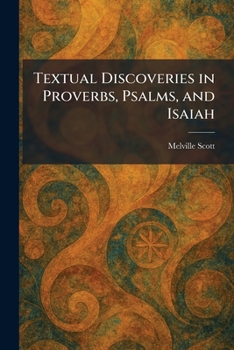
Textual Discoveries in Proverbs, Psalms, and Isaiah

"Textual Discoveries in Proverbs, Psalms, and Isaiah" offers a meticulous scholarly exploration into the linguistic and structural nuances of three pivotal books of the Old Testament. Melville Scott provides an in-depth analysis of the textual variations and philological complexities found within the Wisdom literature of "Proverbs" and "Psalms," as well as the profound prophetic writings of "Isaiah."
The work focuses on identifying and clarifying obscure passages through a rigorous examination of original languages and historical contexts. By highlighting specific discoveries in the text, Scott aims to provide a clearer understanding of the biblical message, addressing translation discrepancies and offering fresh interpretations that remain grounded in academic tradition. This study is particularly valuable for its dedication to textual integrity and its efforts to bridge the gap between ancient manuscripts and modern comprehension.
Designed for theologians, students of divinity, and those interested in the historical-critical method, "Textual Discoveries in Proverbs, Psalms, and Isaiah" stands as a significant contribution to biblical studies. It emphasizes the enduring importance of careful textual scrutiny in uncovering the depth and meaning of sacred scripture.
This work has been selected by scholars as being culturally important, and is part of the knowledge base of civilization as we know it. This work was reproduced from the original artifact, and remains as true to the original work as possible. Therefore, you may see the original copyright references, library stamps (as most of these works have been housed in our most important libraries around the world), and other notations in the work.
This work is in the public domain in the United States of America, and possibly other nations. Within the United States, you may freely copy and distribute this work, as no entity (individual or corporate) has a copyright on the body of the work.
As a reproduction of a historical artifact, this work may contain missing or blurred pages, poor pictures, errant marks, etc. Scholars believe, and we concur, that this work is important enough to be preserved, reproduced, and made generally available to the public. We appreciate your support of the preservation process, and thank you for being an important part of keeping this knowledge alive and relevant.
Customer Reviews
ThriftBooks ® and the ThriftBooks ® logo are registered trademarks of Thrift Books Global, LLC
