


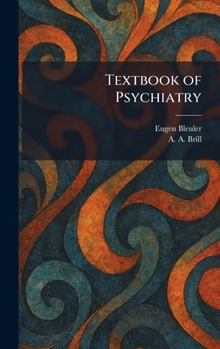
Textbook of Psychiatry

Select Format
Select Condition 
Book Overview
"Textbook of Psychiatry" stands as a foundational pillar in the history of clinical psychology and medical science. Written by the influential Swiss psychiatrist Eugen Bleuler and translated into English by the pioneering psychoanalyst A.A. Brill, this comprehensive volume offers an exhaustive exploration of mental disorders as understood during a transformative era of psychiatric thought. Bleuler, renowned for his revolutionary work on dementia praecox and for coining terms such as "schizophrenia" and "autism," provides a rigorous framework for diagnosing and treating various psychological conditions.
The work delves into the symptomatology, etiology, and prognosis of numerous mental illnesses, blending clinical observation with theoretical insights. It bridges the gap between traditional organic psychiatry and the emerging school of psychoanalysis, reflecting the collaborative influence of Brill's perspective. Covering topics from sensory disturbances to complex delusions, "Textbook of Psychiatry" remains an essential resource for those interested in the evolution of mental health care and the development of psychiatric classification systems. Its historical significance and detailed case descriptions provide invaluable context for the study of human behavior and the origins of modern diagnostic practice.
This work has been selected by scholars as being culturally important, and is part of the knowledge base of civilization as we know it. This work was reproduced from the original artifact, and remains as true to the original work as possible. Therefore, you may see the original copyright references, library stamps (as most of these works have been housed in our most important libraries around the world), and other notations in the work.
This work is in the public domain in the United States of America, and possibly other nations. Within the United States, you may freely copy and distribute this work, as no entity (individual or corporate) has a copyright on the body of the work.
As a reproduction of a historical artifact, this work may contain missing or blurred pages, poor pictures, errant marks, etc. Scholars believe, and we concur, that this work is important enough to be preserved, reproduced, and made generally available to the public. We appreciate your support of the preservation process, and thank you for being an important part of keeping this knowledge alive and relevant.
Customer Reviews
ThriftBooks ® and the ThriftBooks ® logo are registered trademarks of Thrift Books Global, LLC
