


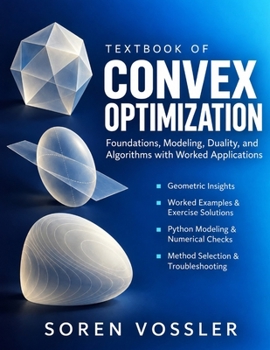
Textbook of Convex Optimization: Foundations, Modeling, Duality, and Algorithms with Worked Applications

Finding an answer is only half the challenge. Can you prove it solves the right problem?
Turning a practical question into a sound optimization model takes more than knowing formulas. You need to recognize convex structure, choose an appropriate method, and understand what the result actually establishes.
Textbook of Convex Optimization connects these skills through a progression from geometric foundations to algorithms and worked applications. Clear explanations, explicit assumptions, and carefully developed arguments help you follow the reasoning behind each modeling choice and mathematical guarantee.
Inside, you will learn to:
Recognize and formulate convex problems, working with convex sets and functions, linear and quadratic models, and conic and semidefinite representations.
Justify an answer using optimality conditions, Lagrangian duality, KKT certificates, and sensitivity analysis.
Choose numerical methods with purpose, including gradient, projected-gradient, subgradient, proximal, Newton, and interior-point methods.
Evaluate computational results through Python and CVXPY examples that address scaling, residuals, solver outcomes, and independent checks.
Connect theory to decisions through worked applications in resource allocation under uncertainty, regularized estimation, and experimental design.
For independent study, the book includes a readiness diagnostic, focused mathematical refreshers, geometric illustrations, and chapter exercises with dedicated solutions and hints. Troubleshooting guidance and a method-selection reference support you when a calculation stalls or several approaches seem possible.
Written for advanced undergraduates, beginning graduate students, and independent learners with introductory linear algebra and multivariable calculus, this textbook brings mathematical rigor to the practical work of building, solving, and interpreting convex optimization models.
Get your copy of Textbook of Convex Optimization today and build the skills to formulate problems clearly, select methods intelligently, and defend your conclusions.
Customer Reviews
ThriftBooks ® and the ThriftBooks ® logo are registered trademarks of Thrift Books Global, LLC
