


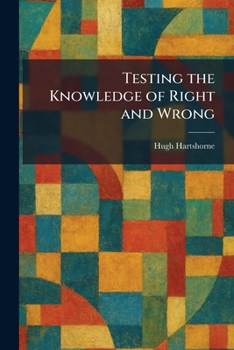
Testing the Knowledge of Right and Wrong

Select Format
Select Condition 
Book Overview
"Testing the Knowledge of Right and Wrong" is a foundational study in the psychological measurement of moral judgment. Written by Hugh Hartshorne, this work delves into the complex challenge of evaluating how individuals, particularly children and students, comprehend and apply ethical principles. Published during a pivotal era for character education, the book explores the methodology behind quantifying moral knowledge and the practical implications for educators and religious leaders.
The text examines various experimental approaches to testing ethical awareness, moving beyond abstract philosophy to provide empirical tools for assessment. Hartshorne's rigorous analysis addresses the intersection of psychology, education, and ethics, aiming to provide a scientific basis for religious and moral training. By focusing on the cognitive aspects of morality-specifically the ability to distinguish between right and wrong-this work provides valuable insights into the development of character and the effectiveness of instructional programs.
A significant contribution to the fields of educational psychology and social science, "Testing the Knowledge of Right and Wrong" remains a critical resource for understanding the history of moral testing. It offers a detailed look at the early 20th-century effort to harmonize scientific inquiry with traditional values, making it an essential read for those interested in the evolution of pedagogy and the measurement of human behavior.
This work has been selected by scholars as being culturally important, and is part of the knowledge base of civilization as we know it. This work was reproduced from the original artifact, and remains as true to the original work as possible. Therefore, you may see the original copyright references, library stamps (as most of these works have been housed in our most important libraries around the world), and other notations in the work.
This work is in the public domain in the United States of America, and possibly other nations. Within the United States, you may freely copy and distribute this work, as no entity (individual or corporate) has a copyright on the body of the work.
As a reproduction of a historical artifact, this work may contain missing or blurred pages, poor pictures, errant marks, etc. Scholars believe, and we concur, that this work is important enough to be preserved, reproduced, and made generally available to the public. We appreciate your support of the preservation process, and thank you for being an important part of keeping this knowledge alive and relevant.
Customer Reviews
ThriftBooks ® and the ThriftBooks ® logo are registered trademarks of Thrift Books Global, LLC
