


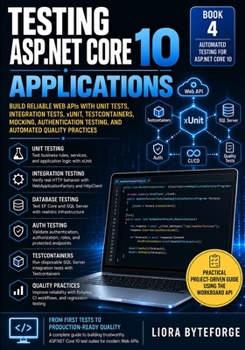
Testing ASP.NET Core 10 Applications: Build Reliable Web APIs with Unit Tests, Integration Tests, xUnit, Testcontainers, Mocking, Authentication ... Practices (The Practical ASP.NET Core Series)

Build ASP.NET Core applications you can test, refactor, and deploy with confidence.
A Web API may work perfectly today, but what happens after the next refactor, database migration, authentication change, or new feature?
Testing ASP.NET Core 10 Applications is a practical guide to building reliable automated tests for modern ASP.NET Core applications. As Book 4 of The Practical ASP.NET Core Series, it continues the WorkBoard API project and shows how to verify the application from individual business rules all the way to real HTTP, database, authentication, and production workflows.
Rather than focusing on test counts or chasing code-coverage percentages, this book teaches you how to choose the smallest realistic testing boundary that can prove the behavior that matters.
You will learn how to:
Write clear and maintainable tests with xUnit
Test business rules and application services
Use fakes, stubs, and mocks without over-mocking
Test asynchronous code and failure scenarios
Build ASP.NET Core integration tests with WebApplicationFactory
Send real HTTP requests using HttpClient
Test status codes, validation, serialization, and ProblemDetails
Verify filtering, sorting, pagination, and API contracts
Test Entity Framework Core 10 with real SQL Server
Run disposable database tests with Testcontainers for .NET
Test database migrations, relationships, queries, and constraints
Verify authentication, JWT tokens, roles, claims, and authorization policies
Test resource ownership and cross-user security boundaries
Build reusable fixtures, factories, and test-data builders
Diagnose and prevent flaky tests
Use code coverage effectively
Run automated tests in continuous integration
Build a dependable production regression strategy
Throughout the book, you will work with the practical WorkBoard API, using realistic testing scenarios instead of disconnected examples.
Who This Book Is ForThis book is ideal for C# and ASP.NET Core developers who already understand basic Web API development and want to build more reliable, maintainable, and production-ready applications.
You do not need advanced testing experience. The concepts progress from focused unit testing to full application integration, SQL Server testing, security testing, and automated quality practices.
By the end of the book, you will understand not only how to write automated tests, but also what to test, where to test it, and how to build a test suite developers can actually trust.
Customer Reviews
ThriftBooks ® and the ThriftBooks ® logo are registered trademarks of Thrift Books Global, LLC
