


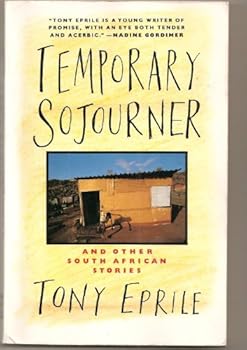
Temporary Sojourner: And Other South African Stories


Select Format
Select Condition 
Book Overview
No Synopsis Available.
Format:Paperback
Language:English
ISBN:067164596X
ISBN13:9780671645960
Release Date:January 1989
Publisher:Fireside
Length:192 Pages
Weight:0.65 lbs.
Dimensions:8.5" x 0.8" x 5.5"
Customer Reviews
1 rating
Complex tales from South Africa
Published by Thriftbooks.com User , 18 years ago
This review was originally published in 1989. Stories by white, anti-apartheid South African exiles have no appeal. Such writers have taken themselves out of history. The minds we want to get into belong to the boers, the hardline Afrikaners; but they do not write elegant short fiction, or, if they do, the editors of American little magazines do not publish them. But make an exception for Tony Eprile, because he at least realizes he's running away from a complicated problem. South Africa is not just a racist country, it is a racist modern country. The zealots who want the American governments and/or corporations to disinvest there may be able to add a small shove that eventually will topple racism; but what will uphold modernity? They should at least read "The Ugly Beetle" and, in their manifestoes, explain how people who set twins out to be trampled by cattle are going to govern a 20th-century state. Or perhaps they would be willing to see southern Africa revert to 19th century conditions. Apartheid as a legal system was only 40 years old, after all, when this collection was published in 1989. But 19th century conditions included the mfecane or "crushing" of the Bantu farmers by the Zulus. Epile does not mention the mfecane. I bring it up only because I doubt whether the anti-apartheid moralizers have ever heard of it. Eprile is not that kind of political writer. He strikes me as another George Orwell, who always wanted to write a purely "literary" novel but didn't because the times wouldn't let him. Eprile's interest is focused on the direct relation between two human beings -- a white boy and his black nanny, a young man and his girlfriend; or, on the other side of the coin, a black janitor in a prison or a Greek grocer in his Johannesburg shop, both men deliberately withdrawing from contact with the people around them. Orwell was like that, too, especially in "1984," but neither can Eprile tell a story without the intrusion of South African politics. It is like the American South of 50 years ago -- everything is valued in the contest of skin color: "The (white) women's voices whine, the men's are suspicious, quick to turn to threat," even when they are just going out to dinner in a nice restaurant. In a twisted society, even ordinary decent behavior can be politically incorrect. In "A Soweto Education" Teacher Moreno, who chooses a moderate path, ends up a criminal. "His own solitariness and hardworking scholarship would now be seen as clandestine activity by a fugitive and secret plotter of insurrection; the worst students, those who blamed the world for their own shortcomings, would take heart from what they would believe to have been Teacher's role. He saw how easy it was to make a mockery of a man's life, to overturn his dreams and leave him with nothing." In the end, Eprile's stories deserve attention because they are complex, as the situation in South Africa is complex. In the 21st century, they still repay reading, because
Copyright © 2026 Thriftbooks.com Terms of Use
| Privacy Policy | Do Not
Sell/Share My Personal Information | Cookie Policy | Cookie Preferences | Accessibility Statement
ThriftBooks® and the ThriftBooks® logo are registered trademarks of Thrift Books Global, LLC
ThriftBooks® and the ThriftBooks® logo are registered trademarks of Thrift Books Global, LLC
