


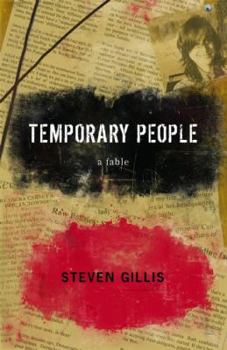
Temporary People


Fiction. Revolution rocks and rolls. An ex-tv star seizes power and tries to turn daily life into an endless film. TEMPORARY PEOPLE is a political fable of the first order. Set on the island of Bamerita, a country whose "history is like the rim of a wheel made to turn round and round, our political cycles nothing if not redundant," Gillis' third novel, following Walter Falls and The Weight of Nothing , TEMPORARY PEOPLE explores the human condition in all its most vulnerable exposures. A brilliant send up of modern life turned inside out by the inescapable powers of history and fate, filled with pathos and humor, Gillis deftly explores the complexities of survival and choice in a world perpetually on the verge of going mad. Sharp and satirical, a breathtakingly paced romp, the end will leave you drop-jawed and wanting more. TEMPORARY PEOPLE is a book for the ages and once again Gillis delivers.
Format:Hardcover
Language:English
ISBN:0976899361
ISBN13:9780976899365
Release Date:April 2008
Publisher:Black Lawrence Press
Length:205 Pages
Weight:0.85 lbs.
Dimensions:8.5" x 0.6" x 5.5"
Customer Reviews
2 ratings
Madness as show biz
Published by Thriftbooks.com User , 17 years ago
Years ago, I saw a Jim Carrey movie called "The Truman Show." It was about a man whose entire life, unbeknownst to him, played out on a movie stage while the rest of the world watched. Steven Gillis's novel, "Temporary People," reminded me of that movie ... only with a much darker palette of colors. Much darker. Add a touch of the surreal, and you have Gillis, likened to Kurt Vonnegut by some (and I would agree with the comparison). "Temporary People" is called a fable by the author, explaining the designation in the first pages of his unfolding story, in which the island of Bamerita, floating unattached some 2,000 miles south of Iceland, has become a movie set directed by a madman, called Teddy Lamb a.k.a the General: "The scenes for Teddy's movie are shot out of sequence and no one can say for certain what the film's about. Even when the soldiers come and order us into our costumes, we're not shown a script. At best, we hear rumors that the movie's a multi-generational saga weaved through the telling and retelling of a 3,000 year old fable. The focus of the fable changes, however, each time the rumor's repeated. Teddy reviews all the daily rushes, assesses the caliber of our performance. Everyone's uneasy about how they appear. The perception we give is not always intended. Our fear isn't artistic but rather a concern for our safety. In evaluating the scenes, Teddy's impatient with people who disappoint him. Those found deficient are removed from the film and rarely heard from again. `That,' Teddy says, `is show biz.'" Under this guise of movie-making, Teddy rules as a slaughtering dictator would, even while doing so with a perverted sense of humor. Madness, if you will. The previous government officials are filmed as they are tied to logs, then pulled in two, set to float on the ocean waves. The population of Bamerita falls quietly into place after that. Until, of course, they rise to revolt. As any population, given time and wearing away of patience with brutality, will. A crew of "actors," i.e. citizens, take the lead, with characters such as Andre Mafante, an insurance salesman who tries to promote non-violent means of revolt, and his friend, Emilo, whose rebelliousness culminates in sewing his own ears, eyes and mouth shut. One of Gillis's most disturbing scenes is when Teddy torments Emilo into unwilling laughter and pained screams, effectively tearing up his stitched mouth into meaty shreds. The satire is effective. Gillis is successful in painting the madness, the irrational behavior of an oppressive government, the mass fear in response, and the distortion of reality that taking away basic liberties must involve when one manipulates the many. If this echoes of current political scenarios, it should. In his characters, Gillis illustrates different forms of resistance and rebellion: indifference, self-serving cowardice, passive and active resistance, heroic if perhaps misguided protest and bloody coups. All done with a touch of Ho
By All Means Available
Published by Thriftbooks.com User , 17 years ago
Ours is a literature grown too literal, too often out of touch with the darknesses our fabulist older forms -- the fable, the parable, the allegory -- were made to mine. Some of our best writers -- Margaret Atwood, A.S. Byatt, Kurt Vonnegut, and Ray Bradbury among them -- have been brave enough to wade into these waters, and the reports they have brought back -- our Handmaid's Tale, our Cat's Cradle, our Fahrenheit 451 -- have often taught us more about our present and foolhardy condition than any straight description of the same could offer. So it with Steven Gillis's Temporary People, a fable fit to sit at the table with such company. Here we have a villain to beat the band, one Teddy Lamb, a.k.a the General, a failed television actor turned banana republic dictator of Bamerita, a Caribbean island he has turned into a giant movie set. Our narrator, insurance salesman Andre Manfante, has Teddy's number, and says what passes for the unsayable in Bamerita: "Our suspicion had long been that Teddy was more interested in blurring the lines of reality than finishing a film, that he was looking for a way to present all acts of violence as make believe, and in so doing, confuse what was and wasn't part of our normal daily life." If the readers suspects a connection to American global policy, the reader would be right, and the novel's second half will make the connection explicit. But Gillis is not chiefly concerned with present day particulars so much as he is with a broader human tendency to acquire power and then keep it by all means available -- through violence, obfuscation, trickery, deceit, and even the appearance of love. Toward this end, the novel invokes Dylan, Lennon, Gandhi, Milosz, Bob Marley, Joni Mitchell, Benjamin Franklin -- those idealists of history who nonetheless had to reckon with the pragmatic once they found stage and audience. The political philosophy is front and center, and boldly so, but never at the expense of story, and never at the expense of character. Temporary People is an entertaining book, but it is not strictly an entertainment. Ultimately, it is an indictment, and not just of the workings of governments, but also of the exigencies of the human heart. Gillis has done readers everywhere a great service.
Copyright © 2025 Thriftbooks.com
Terms of Use | Privacy Policy | Do Not Sell/Share My Personal Information | Cookie Policy | Cookie Preferences | Accessibility Statement
ThriftBooks ® and the ThriftBooks ® logo are registered trademarks of Thrift Books Global, LLC
ThriftBooks ® and the ThriftBooks ® logo are registered trademarks of Thrift Books Global, LLC
