


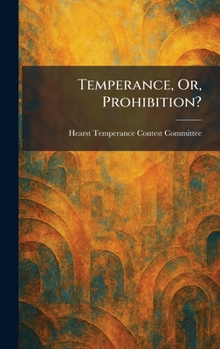
Temperance, Or, Prohibition?

"Temperance, Or, Prohibition?" examines the complex and contentious debate surrounding alcohol regulation in the United States during the late 1920s. This work, compiled by the Hearst Temperance Contest Committee, provides a comprehensive overview of the social, ethical, and political arguments that defined the Prohibition era. As the nation grappled with the consequences of the Eighteenth Amendment, this volume offers a critical look at the distinction between state-enforced abstinence and the movement for personal temperance.
The text serves as an essential historical record, capturing the diverse perspectives of a society at a crossroads. It explores key themes such as public health, crime, legislative efficacy, and the role of government in regulating personal behavior. By presenting varied viewpoints on how to best address the challenges of alcohol consumption, "Temperance, Or, Prohibition?" provides readers with a deep understanding of the ideological battles that shaped 20th-century American policy.
This work is a valuable resource for students of history, political science, and sociology, offering unique insight into the cultural zeitgeist of the 1920s. It highlights the enduring questions of law and morality that continue to resonate in modern public discourse.
This work has been selected by scholars as being culturally important, and is part of the knowledge base of civilization as we know it. This work was reproduced from the original artifact, and remains as true to the original work as possible. Therefore, you may see the original copyright references, library stamps (as most of these works have been housed in our most important libraries around the world), and other notations in the work.
This work is in the public domain in the United States of America, and possibly other nations. Within the United States, you may freely copy and distribute this work, as no entity (individual or corporate) has a copyright on the body of the work.
As a reproduction of a historical artifact, this work may contain missing or blurred pages, poor pictures, errant marks, etc. Scholars believe, and we concur, that this work is important enough to be preserved, reproduced, and made generally available to the public. We appreciate your support of the preservation process, and thank you for being an important part of keeping this knowledge alive and relevant.
Related Subjects
History Political Science Politics & Social Sciences Social Science Social SciencesCustomer Reviews
ThriftBooks ® and the ThriftBooks ® logo are registered trademarks of Thrift Books Global, LLC
