


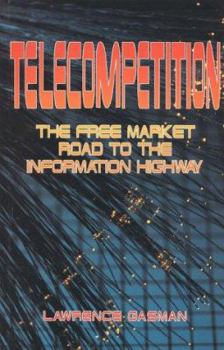
Telecompetition: The Free Market Road to the Information Highway
No Customer Reviews

We are on the verge of gaining access to a cornucopia of information and entertainment, but government regulation threatens to bottle up the new technology. Cable and telephone companies are both protected from competition and forbidden to enter new markets. The Clinton administration considers spending billions of taxpayers' dollars to build an information superhighway that private companies are champing at the bit to build at no cost to the government. Today's Information Revolution is driven by three smaller revolutions in microelectronic, digital, and optical technology. The microelectronic revolution, based on the transistor and then the microprocessor, has given us word processors, programmable VCRs, featureful home telephones, and personal computers, all of which have moved computing power away from a technical elite and closer to the average citizen. The digital revolution allows information in any form - even graphics and sound - to be processed by machines. And the fiber-optic revolution means that much more information can be transmitted simultaneously. Together, those technological changes are erasing the boundaries that have separated voice, video, text, and data communications and are making regulatory policy as obsolete as dial telephones and vacuum tubes. Regulations have been based on the outmoded notions of natural monopoly, spectrum scarcity, and captive audiences - none of which seem very compelling in the modern era of Telecompetition. Communications analyst Lawrence Gasman argues that the best way to gain the benefits of new information technology is not a government-backed communications superhighway but a policy of free markets, deregulation, propertyrights, and upholding the First Amendment. The most important role for government is to protect property rights, then stand back and watch as new technologies break through the boundaries of old regulations. Telecompetition is the comprehensive case for deregulating telecommunications
Format:Hardcover
Language:English
ISBN:1882577086
ISBN13:9781882577088
Release Date:March 1994
Publisher:Cato Institute
Length:177 Pages
Weight:1.11 lbs.
Dimensions:9.0" x 1.0" x 6.0"
Customer Reviews
0 rating
Copyright © 2025 Thriftbooks.com
Terms of Use | Privacy Policy | Do Not Sell/Share My Personal Information | Cookie Policy | Cookie Preferences | Accessibility Statement
ThriftBooks ® and the ThriftBooks ® logo are registered trademarks of Thrift Books Global, LLC
ThriftBooks ® and the ThriftBooks ® logo are registered trademarks of Thrift Books Global, LLC
