


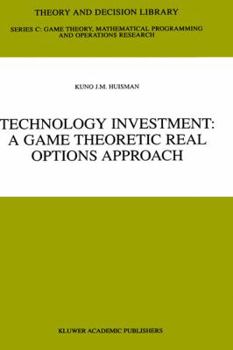
Technology Investment: A Game Theoretic Real Options Approach
No Customer Reviews

This chapter is organized as follows. The economic problem on which this book focuses is motivated in Section 1. The two tools used to study this economic problem, which are real options theory and game theory, are discussed in Sections 2 and 3, respectively. Section 4 surveys the contents of this book. In Section 5 some promising extensions of the research presented in this book are listed. 1. TECHNOLOGY INVESTMENT Investment expenditures of companies govern economic growth. Es- pecially investments in new and more efficient technologies are an impor- tant determinant. In particular, in the last two decades an increasing part of the investment expenditures concerns investments in informa- tion and communication technology. Kriebel, 1989 notes that (already) in 1989 roughly 50 percent of new corporate capital expenditures by major United States companies was in information and communication technology. Due to the rapid progress in these technologies, the tech- nology investment decision of the individual firm has become a very complex matter. As an example of the very high pace of technological improvement consider the market for personal computers. IBM intro- duced its Pentium personal computers in the early 1990s at the same price at which it introduced its 80286 personal computers in the 1980s. Therefore it took less than a decade to improve on the order of twenty times in terms of both speed and memory capacities, without increasing the cost (Yorukoglu, 1998).
Format:Hardcover
Language:English
ISBN:0792374878
ISBN13:9780792374879
Release Date:November 2001
Publisher:Springer
Length:262 Pages
Weight:1.24 lbs.
Dimensions:0.8" x 6.6" x 9.7"
Customer Reviews
0 rating
Copyright © 2026 Thriftbooks.com Terms of Use
| Privacy Policy | Do Not
Sell/Share My Personal Information | Cookie Policy | Cookie Preferences | Accessibility Statement
ThriftBooks® and the ThriftBooks® logo are registered trademarks of Thrift Books Global, LLC
ThriftBooks® and the ThriftBooks® logo are registered trademarks of Thrift Books Global, LLC
