


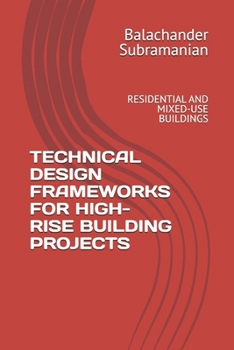
Technical Design Frameworks for High-Rise Building Projects: Residential and Mixed-Use Buildings
No Customer Reviews

High-rise residential and mixed-use developments have become defining features of modern cities. As urban populations continue to grow and land availability becomes increasingly constrained, vertical development has emerged as a critical solution for accommodating residential, commercial, hospitality, retail, and community functions within integrated urban environments. These projects are among the most complex forms of construction undertaken today, requiring the seamless integration of architecture, structural engineering, building services, sustainability, digital technologies, fire and life safety systems, and operational considerations. The successful delivery of a high-rise development demands far more than architectural creativity or engineering excellence in isolation. It requires a systematic framework that aligns planning, design, analysis, coordination, compliance, constructability, operational readiness, and long-term asset performance. Every decision-from site planning and tower orientation to fa ade design, structural systems, vertical transportation, sustainability strategies, smart building technologies, and digital engineering-has a direct impact on project outcomes. Technical Design Frameworks for High-Rise Residential and Mixed-Use Building Projects has been developed to provide a comprehensive and practical roadmap for navigating these challenges. The book brings together fifty integrated technical design frameworks that collectively address the entire design lifecycle of high-rise developments. Each framework is structured to provide clear objectives, guiding principles, implementation methodologies, governance requirements, deliverables, key performance indicators, and best-practice recommendations. The frameworks cover the full spectrum of technical disciplines, including master planning, urban integration, architectural design, structural engineering, wind engineering, seismic design, geotechnical engineering, fa ade engineering, building envelope performance, vertical transportation systems, fire engineering, HVAC systems, electrical systems, plumbing systems, smart building technologies, sustainability, BIM, digital engineering, and operational integration. In addition to addressing technical excellence, the book places strong emphasis on sustainability, resilience, occupant wellbeing, digital transformation, ESG objectives, smart city integration, and lifecycle asset management. These themes are increasingly critical as developers, designers, operators, and investors seek to create buildings that are not only efficient and profitable but also environmentally responsible and future-ready. Whether developing a luxury residential tower, a mixed-use urban precinct, a supertall landmark, or a transit-oriented development, project teams require structured methodologies that reduce risk, improve coordination, enhance design quality, and maximize long-term value. This book serves as a practical reference guide for achieving those objectives. The frameworks presented in this publication can be applied across all stages of project development-from feasibility studies and concept design through detailed engineering, construction coordination, commissioning, and facility operations. By adopting these frameworks, organizations can establish consistent standards, improve collaboration, strengthen governance, and deliver world-class high-rise developments that meet the expectations of owners, occupants, investors, regulators, and communities. Ultimately, this book is intended to serve as both a technical reference and a strategic management tool, helping professionals transform complex design challenges into successful, sustainable, and high-performing built environments.
Format:Paperback
Language:English
ISBN:B0H4TM8DRB
ISBN13:9798181074118
Release Date:June 2026
Publisher:Independently Published
Length:744 Pages
Weight:2.15 lbs.
Dimensions:1.5" x 6.0" x 9.0"
Customer Reviews
0 rating
Copyright © 2026 Thriftbooks.com
Terms of Use | Privacy Policy | Do Not Sell/Share My Personal Information | Cookie Policy | Cookie Preferences | Accessibility Statement
ThriftBooks ® and the ThriftBooks ® logo are registered trademarks of Thrift Books Global, LLC
ThriftBooks ® and the ThriftBooks ® logo are registered trademarks of Thrift Books Global, LLC
