


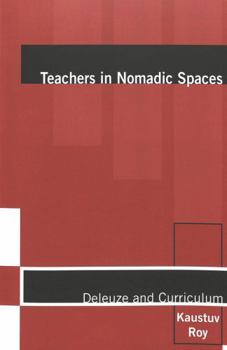
Teachers in Nomadic Spaces: Deleuze and Curriculum

Teachers in Nomadic Spaces is fieldwork in curriculum theory, weaving vital strands of Gilles Deleuze's constructivist philosophy into a case study of teacher induction and becoming in an urban... This description may be from another edition of this product.
Format:Paperback
Language:English
ISBN:0820467375
ISBN13:9780820467375
Release Date:April 2003
Publisher:Peter Lang Inc., International Academic Publi
Length:186 Pages
Weight:0.62 lbs.
Customer Reviews
1 rating
Curriculum as Rhizome: Urban Schools as Fresh Horizons
Published by Thriftbooks.com User , 16 years ago
For most new teachers in urban schools, the first day of school is a rude awakening (as I experienced myself). What most of these fledgling educators - products, no doubt, of middle class, suburban upbringings (again, like myself)- encounter is a far cry from the normative, reified training they received in their respective educational courses; instead of a fixed environment, they find an exceedingly fluid one that is outside their realm of understanding. Small wonder, then, that many (most?) of these highly-qualified but inexperienced teachers end up quiting as soon as possible and heading for the suburbs (unlike myself, who stayed on in an urban school). That said, if I were a professor teaching a preparatory course on education, I would definitely make Kaustuv Roy's wake up call in Teachers In Nomdaic Spaces required reading for all aspiring teachers, as this outstandng text forces potential educators to think outside the proverbial box (in this case, traditional educational discourse). Here, Roy incorporates an empirical, pluralistic "Deleuzian lens" - framed by "difference," not staid representation - to examine urban school settings in a vastly POSITIVE sense; where others see chaos and negativity, Roy, conversely, sees the potential for growth and the possibility of an ecological development within a local space or community. The key, Roy suggests, is to distance ourselves from oppressive "signifying regimes that project the signs of learning as bounded, convergent, and a function of representation." Roy's fluid "nomadic space" then becomes a metaphor for Deleuze's "deterritorization." So instead of thrusting the square peg of an (arguably) oppressive pedagogy into the round hole of urban education, Roy uses the work of Deleuze to articulate a radical pedagogy (such as his non-linear, non-hierarchial "rhizome curriculum") better suited for fluid situations such as an urban school setting. Roy's radical thought was such a welcome relief to all the boring education textbooks I had to read in my grad classes! If there is one drawback to Roy's text, however, it is a lack of practical steps for new teachers, and Roy admits this in his conclusion. "What I have attempted throughout this book, and under different guises," writes Roy, "is to shift our focus from macroscopic categories such as teacher, student, curriculum, or even Monday, and the problem of how to deal with them, to the constitutive differences and singularities that can be recomposed once we are in contact with the unsaid of the stated, the unthought of thought, and in general the forces that occupy signs and overcode the differential experience, moving at all times toward a pragmatics of local formations." (p. 176) I strongly recommend this book for any teacher working in an urban, high-need school.
Copyright © 2025 Thriftbooks.com
Terms of Use | Privacy Policy | Do Not Sell/Share My Personal Information | Cookie Policy | Cookie Preferences | Accessibility Statement
ThriftBooks ® and the ThriftBooks ® logo are registered trademarks of Thrift Books Global, LLC
ThriftBooks ® and the ThriftBooks ® logo are registered trademarks of Thrift Books Global, LLC
