


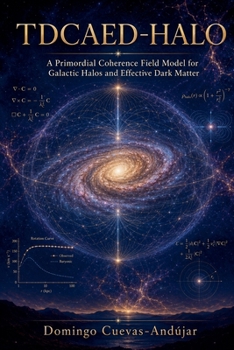
Tdcaed-Halo

TDCAED-HALO: A Primordial Coherence Field Model for Galactic Halos and Effective Dark Matter presents a theoretical and computational framework for exploring one of the deepest mysteries in modern cosmology: the invisible structure that sustains galaxies.
In this work, Domingo Cuevas-And jar develops TDCAED-HALO as a specific application of the Domingo Cuevas-And jar Theory of the Divine Roar (TDCAED) to the problem of galactic halos and effective dark matter. The book proposes that galactic halos may be studied as coherent configurations of a primordial scalar field, represented by Φ, capable of generating effective density, enclosed mass, and rotation curves comparable with astronomical observations.
The model is not presented as a confirmed theory, but as a mathematical and scientific program under development. Its value lies in its structure: a defined Lagrangian, a scalar-field potential, Euler-Lagrange equations, an energy-momentum tensor, radial density profiles, dimensionless numerical systems, Python-based simulation, observational fitting, and falsifiability criteria. The book asks the reader to examine a chain of reasoning that moves from hypothesis to equation, from equation to simulation, and from simulation to possible observational test.
The book examines dark matter, dark energy, vacuum structure, scalar fields, solitons, self-gravitating halos, smooth cores, flat rotation curves, NFW, Burkert, and isothermal profiles. It also includes technical appendices on tensor conventions, energy-momentum derivation, vacuum expansion, unit conversion, base Python code, reproducibility, and a technical glossary. These materials help the reader understand both the conceptual proposal and the computational machinery behind it.
At its core, TDCAED-HALO asks a precise question: Can primordial coherence produce observable gravitational effects in galaxies?
This question is developed through the idea that the invisible mass inferred in galactic systems may be approached not only as a population of undetected particles, but also as an effective field structure. In this framework, the halo is treated as a possible radial configuration of a field whose density can be calculated, whose enclosed mass can be integrated, and whose rotation curve can be compared with data.
Rather than offering a closed answer, this book builds a rigorous path for investigation. The model must produce positive densities, monotonic enclosed masses, stable parameters, regular solutions, and rotation curves that can compete statistically with standard halo models. If it fails those tests, it must be revised or rejected. If it survives them, it may open a new line of research into the hidden structure of the cosmos.
TDCAED-HALO emphasizes falsifiability. It does not claim that dark matter has been definitively solved or that standard cosmology has been replaced. Instead, it defines conditions under which the model may be evaluated: density must remain physically meaningful, the potential must remain stable, the numerical system must avoid singular behavior, and the predicted curves must be judged against observations and competing models.
The work connects theoretical cosmology with practical computation. Through its dimensionless radial system and Python-based implementation, TDCAED-HALO becomes a model that can be simulated, plotted, tested, compared, and reproduced. This makes the book useful as a foundation for future numerical experiments, galaxy fitting, and open scientific review.
This is not a book of speculative assertion. It is an attempt to transform a cosmological intuition into equations, simulations, and falsifiable predictions. Its purpose is not to close the mystery of dark matter, but to offer a disciplined framework through which a new possibility can be explored with rigor and intellectual responsibility.
Customer Reviews
ThriftBooks ® and the ThriftBooks ® logo are registered trademarks of Thrift Books Global, LLC
