


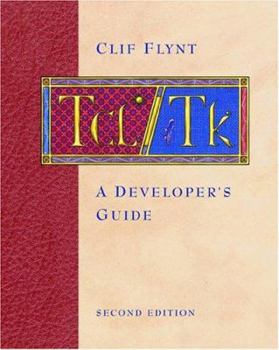
Tcl/Tk: A Developer's Guide (The Morgan Kaufmann Series in Software Engineering and Programming)


Select Format
Select Condition 
Book Overview
Tcl/Tk (Tool Command Language/Tool Kit) makes it fast and easy to implement any type of application, from games to network analyzers. Tcl/Tk is a full-bodied, mature programming platform used by NASA rocket scientists, Wall Street database experts, Internet designers, and open source programmers around the world. Tcl/Tk's multi-faceted and extensible nature make it ideal for developing end-user GUIs, client/server middleware, Web applications, and more. You can code completely in Tcl, use any of hundreds of extensions, call C or Java subroutines from Tcl/Tk, or use Tcl to glue legacy applications together.Written from a programmer's perspective, Tcl/Tk: A Developer's Guide describes how to use Tcl's standard tools and the unique features that make Tcl/Tk powerful: including graphics widgets, packages, namespaces, and extensions. With this book an experienced programmer will be able to code Tcl in a few hours. In just a few chapters you will learn about Tcl features that allow you to isolate and protect your code from being damaged in large applications. You will even learn how to extend the language itself.Tcl/Tk: A Developer's Guide clearly discusses development tools, proven techniques, and existing extensions. It shows how to use Tcl/Tk effectively and provides many code examples. This fully revised new edition is the complete resource for computer professionals, from systems administrators to programmers. It covers versions 7.4 to 8.4 and includes a CD-ROM containing the interpreters, libraries, and tutorials to get you started quickly. Additional materials in the book include case studies and discussions of techniques for the advanced user.On the CD-ROM*Distributions for Tcl 8.3 and 8.4 for Linux, Solaris, Macintosh, and Windows. *A copy of ActiveTcl from ActiveState. *The latest release of TclTutor.*How-to's and tutorials as well as copies of all the tools discussed in the book.*The author's "Tclsh Spot" articles from: login; magazine and the "Real World" Tcl/Tk chapters from the first edition.*Demo copies of commercial development tools from ActiveState and NeatWare.*Many open source Tcl/Tk development tools.*Tcl/Tk design guidelines.
Format:Paperback
Language:English
ISBN:1558608028
ISBN13:9781558608023
Release Date:May 2003
Publisher:Morgan Kaufmann
Length:758 Pages
Weight:2.96 lbs.
Dimensions:9.3" x 1.5" x 7.5"
Customer Reviews
5 ratings
It made me feel like a computer again (in a good way)
Published by Thriftbooks.com User , 17 years ago
Clif's book is good for learning not only the basics of Tcl/Tk (which this book does very well), but also when to use each of the skills you use. Each lesson is digestible and fluid and builds upon the last, always in a useful, goal-oriented way. Through this, his diction and use of metaphors, you can start to see and make your own his deep understanding of the language and its many various applications.
A Developers guide to Tcl
Published by Thriftbooks.com User , 18 years ago
Tcl is a multi-faceted language. You can use Tcal a s a command scripting language, as a powerful multi platform interpreted language, as a rapid prototyping platform, or as a library of interpreter calls within another project. Tcl's simple syntax makes single use scripts quick and easy to write. Tcl's modulations and encapsulation features help you develop large projects. Tcl's extensibility makes it easy to use Tcl as the base language across a broad range of projects, from machine control to database applications to electronic design applications, network test devices etc. I found this book very well structured and informative with a level of detailed attuned for both as a reference for an experiences programmer to a learning guide for a novice.
Like it says, a developer's guide.
Published by Thriftbooks.com User , 20 years ago
The book is in textbook format, with problems to be worked at the end of each chapter. The problems are of different levels of difficulty. No answers in the back. The book itself is NOT concise, imho, and there seems to be many references to "see the CD" for complete information. Clearly, it is intended that you work with the CD to first accomplish the tutorials, and then use the book to polish what you've learned via the CD. The cute little "scroll" way of navigating about the CD works well in Windows, but doesn't work on my linux machine. The CD is also the only place where there is "A printable Reference"; at least, that's what the book says. I'm still looking for it. You clearly get all the stuff you need to become a Tcl/Tk master, but with so much material, the reader is left to blunder through it all the best he can. To meet the goal of learning Tcl/Tk quickly as stated in the introduction, a "road map", "plan of attack", or an order of things to read on the disk should have been included.
Best book on Tcl programming
Published by Thriftbooks.com User , 22 years ago
[I'm stingy in my ratings. I could easily give this book 5 stars, but I try to use the entire rating scale.]This book is the best available complement to the free HTML documentation (which is available online, or on CD in many books, including this one). I like the latest version of the Welch book, with its vastly improved index, but I find the explanations to be a bit sparse. For example, I am an experienced programmer in several languages, but I still had a lot of questions about local scoping vis-a-vis namespaces after reading Welch and the docs. Flynt made this topic transparent, with diagrams and examples. I also liked his example of building a tree data structure, which demonstrated to me better than anything that Tcl is simply the wrong language for building trees.That brings me to what I dislike about this book. The code examples are sometimes too long. In my opinion, long code should be only on the CD, to save paper space. And as the book is shorter than Welch's latest, I think the space should not have been wasted.About 1/3 of the book is devoted to Tk, similar to Welch. I have no interest in Tk anymore, so that is all a waste for me. (If you ARE interested in Tk, Effective Tcl/Tk programming is a great source.)There is a fair amount of info on the C library, but I think that Ousterhout's old book is still the best place for that. However, Flynt provides great advice on practical ways of interfacing with C/C++ (SWIG, Starkits, Starpacks).He also details the pro and cons of various Tcl tools, some free. This sort of information goes out of date quickly. For example, the author already mentioned privately to a friend that "nagelfar" is now his own favorite syntax checker. But at the moment, most of his info is current.In short, this is the best book for Tcl developers. But please consider Lua as an alternative interfacing language.
Excellent book for Tcl/Tk developers of all skill levels...
Published by Thriftbooks.com User , 22 years ago
This book covers the Tcl language and the Tk toolkit in exhaustive detail. It works very well as an introduction to Tcl/Tk and as a reference guide for developers more experienced with Tcl/Tk.
Copyright © 2026 Thriftbooks.com Terms of Use
| Privacy Policy | Do Not
Sell/Share My Personal Information | Cookie Policy | Cookie Preferences | Accessibility Statement
ThriftBooks® and the ThriftBooks® logo are registered trademarks of Thrift Books Global, LLC
ThriftBooks® and the ThriftBooks® logo are registered trademarks of Thrift Books Global, LLC
