


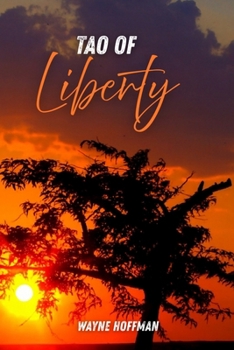
Tao of Liberty

For more than two millennia, the Tao Te Ching has been regarded as a guide for self improvement. But former journalist and public policy expert Wayne Hoffman suggests in that the teachings of Lao Tzu is, simply, the world's oldest written case for limited government.
Hoffman's Tao of Liberty takes the ancient verses of the Tao Te Ching, chapter by chapter, and shows how each can be applied to modern questions surrounding politics and public policy. When done so, one finds alignment with the natural order of the universe, the maximization of liberty, and the avoidance of conflict. Thus, Lao Tzu provides a blueprint to escape the political prison we find ourselves in today.
Inside, you will discover: The Spontaneous Order: How the "Way" of the Tao mirrors the self-organizing nature of free markets and human flourishing.The Paradox of Power: Why the more laws and edicts are imposed, the more "thieves and bandits" are multiplied.Individual Sovereignty: Reclaiming the inner stillness and outer freedom required to live a life of virtue without coercion.The Soft Overcoming the Hard: How decentralized, voluntary communities possess a resilience that rigid bureaucracies can never match.Tao of Liberty is more than a political treatise; it is a call to return to a natural state of being. It invites readers to imagine a world where the state recedes, and the individual flourishes - a world governed by the quiet beauty of the Tao. It is a groundbreaking blend of Eastern wisdom and Western individualism appeals to fans of Lao Tzu, Ayn Rand, and Murray Rothbard, offering a fresh lens on governance in an age of perpetual crisis.
Customer Reviews
ThriftBooks® and the ThriftBooks® logo are registered trademarks of Thrift Books Global, LLC
