


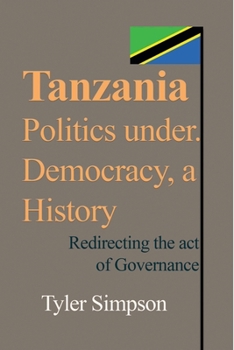
Tanzania Politics under. Democracy, a History
No Customer Reviews

Tanzania Politics under. Democracy, a History. Redirecting the act of Governance. Speaking of broad presidential powers under the Republican Constitution of 1962, Julius Nyerere, the first President of Tanzania wrote to the London Observer in 1963 that " w]e cannot afford liberal checks and balances... Our constitution differs from the American system in that it enables the executive to function without being checked at every turn." Nyerere spoke of his imperial presidency, where the executive, under the one party system, was virtually above all the other constitutional organs of the state and where fundamental freedoms were relegated to socialist objectives of economic development and building national unity. More than fifty years later, not much has changed. The legacy of an absolute presidency still constrains efforts to strengthen democracy and protect fundamental rights in Tanzania. Even though constitutional and political reforms in the 1990s instituted multiparty democracy and operationalised a constitutional bill of rights, proposals to curtail presidential powers were impossible to pass in the given political climate. As the constitutional review process of 2011 led to the adoption of the proposed constitution in October 2014, it is timely to reflect on the state of presidential power and its potential implications for democracy and fundamental freedoms in Tanzania
Format:Paperback
Language:English
ISBN:1714639703
ISBN13:9781714639700
Release Date:February 2021
Publisher:Blurb
Length:122 Pages
Weight:0.38 lbs.
Dimensions:0.3" x 6.0" x 9.0"
Customer Reviews
0 rating
Copyright © 2026 Thriftbooks.com Terms of Use
| Privacy Policy | Do Not
Sell/Share My Personal Information | Cookie Policy | Cookie Preferences | Accessibility Statement
ThriftBooks® and the ThriftBooks® logo are registered trademarks of Thrift Books Global, LLC
ThriftBooks® and the ThriftBooks® logo are registered trademarks of Thrift Books Global, LLC
