


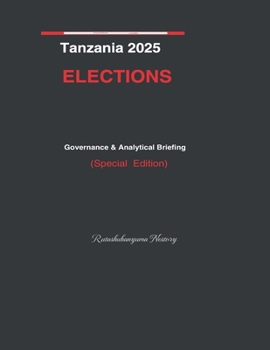
Tanzania 2025 Elections: GOVERNANCE AND ANALYTICAL BRIEFING - Special Edition

This book was written in response to a growing need for systematic documentation and analysis of political and governance developments in Tanzania.
In recent years, public debates surrounding state power, corruption allegations, elite rivalries, and economic management have intensified. Events that once appeared isolated-policy disputes, security controversies, judicial cases, or conflicts within political institutions-have increasingly revealed deeper structural dynamics within the country's governing system.
The chapters compiled in this volume aim to examine these developments with analytical rigor. Each chapter focuses on a specific event, policy issue, or controversy and places it within its broader political and institutional context. By doing so, the book attempts to move beyond surface-level reporting and instead identify recurring patterns that shape governance outcomes.
Particular attention is given to areas where economic resources intersect with political authority. From mining sector controversies involving companies such as Barrick Gold and Acacia Mining, to institutional reforms undertaken under administrations led by figures such as John Pombe Magufuli and Samia Suluhu Hassan, the chapters explore how economic interests and political power interact in shaping public policy.
The work does not seek to offer definitive conclusions about Tanzania's political trajectory. Instead, it provides a documented record and analytical framework through which readers can better understand ongoing developments.
The hope is that this book contributes to informed discussion about governance, accountability, and the future of Tanzania's democratic institutions.
This book was written in response to a growing need for systematic documentation and analysis of political and governance developments in Tanzania.
In recent years, public debates surrounding state power, corruption allegations, elite rivalries, and economic management have intensified. Events that once appeared isolated-policy disputes, security controversies, judicial cases, or conflicts within political institutions-have increasingly revealed deeper structural dynamics within the country's governing system.
The chapters compiled in this volume aim to examine these developments with analytical rigor. Each chapter focuses on a specific event, policy issue, or controversy and places it within its broader political and institutional context. By doing so, the book attempts to move beyond surface-level reporting and instead identify recurring patterns that shape governance outcomes.
Particular attention is given to areas where economic resources intersect with political authority. From mining sector controversies involving companies such as Barrick Gold and Acacia Mining, to institutional reforms undertaken under administrations led by figures such as John Pombe Magufuli and Samia Suluhu Hassan, the chapters explore how economic interests and political power interact in shaping public policy.
The work does not seek to offer definitive conclusions about Tanzania's political trajectory. Instead, it provides a documented record and analytical framework through which readers can better understand ongoing developments.
The hope is that this book contributes to informed discussion about governance, accountability, and the future of Tanzania's democratic institutions.
This book was written in response to a growing need for systematic documentation and analysis of political and governance developments in Tanzania.
Customer Reviews
ThriftBooks ® and the ThriftBooks ® logo are registered trademarks of Thrift Books Global, LLC
