


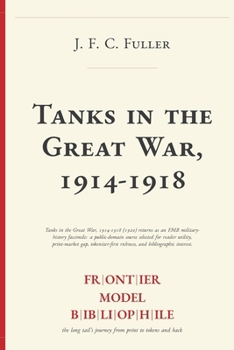
Tanks in the Great War, 1914-1918
No Customer Reviews

Colonel J.F.C. Fuller, one of the most original and controversial military thinkers of the twentieth century, produced this firsthand account of tank operations during the First World War at a moment when the technology and doctrine of armored warfare were being invented simultaneously on the battlefield. Fuller served as chief staff officer of the Tank Corps and was the principal architect of the plan for the Battle of Cambrai in November 1917, the first large-scale tank assault in history. His account combines operational narrative with doctrinal argument, recording not just what the tanks did but what he believed they meant for the future of warfare. The text traces the development of the tank from its origins as a closely guarded secret weapon through its first hesitant deployments on the Somme in September 1916, the disappointments and mechanical failures of early operations, and the progressive refinement of both the machines and the tactics for their employment. The Battle of Cambrai receives extended treatment as the vindication of principles that Fuller and his colleagues had been advocating against considerable institutional resistance. Subsequent operations, including the tank's role in the Allied advances of 1918, are assessed with the analytical eye of an officer who understood both the potential and the limitations of the weapon he championed. The language of the text is particularly notable for capturing the vocabulary of armored warfare as it was being created. Terms like mechanical warfare, tank tactics, and armored doctrine were not inherited from previous military traditions but coined to describe capabilities that had no historical precedent. Fuller's prose preserves the intellectual excitement of officers who recognized they were participating in a revolution in military affairs and were simultaneously fighting battles, developing doctrine, and arguing for institutional recognition of a new arm of service. Fuller's reputation as a military theorist gives this work significance beyond its immediate subject. His post-war writings on mechanized warfare, many of which grew directly from the operational experience recorded here, influenced armored doctrine in Britain, Germany, the Soviet Union, and the United States during the interwar period. Reading this wartime account alongside his later theoretical works reveals how battlefield observation was translated into the principles that would shape the next great conflict. The operational details he recorded at Cambrai, Amiens, and in the Hundred Days formed the empirical foundation upon which his later theoretical edifice was constructed. Modern readers gain a primary source on the birth of armored warfare written by its principal British theorist. Military historians can trace the gap between innovative doctrine and institutional acceptance that characterizes most military revolutions. Students of technology adoption will recognize patterns that recur whenever a disruptive capability challenges established organizational structures. The Frontier Model Bibliophile edition preserves Fuller's complete account, maintaining his analytical voice and period perspective on a technological transformation that reshaped twentieth-century warfare.
Format:Paperback
Language:English
ISBN:B0H84S3RBK
ISBN13:9798259502789
Release Date:November 2026
Publisher:Frontier Model Bibliophile
Length:406 Pages
Weight:1.19 lbs.
Dimensions:0.8" x 6.0" x 9.0"
Customer Reviews
0 rating
Copyright © 2026 Thriftbooks.com
Terms of Use | Privacy Policy | Do Not Sell/Share My Personal Information | Cookie Policy | Cookie Preferences | Accessibility Statement
ThriftBooks ® and the ThriftBooks ® logo are registered trademarks of Thrift Books Global, LLC
ThriftBooks ® and the ThriftBooks ® logo are registered trademarks of Thrift Books Global, LLC
