


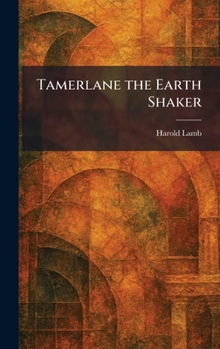
Tamerlane the Earth Shaker

Select Format
Select Condition 
Book Overview
"Tamerlane the Earth Shaker" is a sweeping historical biography that brings to life one of the most formidable conquerors in world history. Written by Harold Lamb, the work chronicles the meteoric rise of Timur, the 14th-century leader who forged a vast empire stretching from the Mediterranean to the borders of China.
Lamb masterfully recreates the world of the medieval steppes, following Timur from his beginnings as a chieftain's son to his coronation as the "Earth Shaker." The narrative delves into the strategic brilliance and ruthless ambition that allowed Timur to topple the Golden Horde, defeat the Ottoman Turks, and transform Samarkand into a jewel of art and architecture. Through vivid storytelling, the book examines the complex character of a man who was simultaneously a patron of the sciences and a bringer of total war.
Providing deep insight into the geopolitical landscape of Central Asia, this work remains an essential read for those interested in military history, the legacy of the Mongol successors, and the dramatic shifts of power that shaped the medieval world. Lamb's evocative prose ensures that the history of this legendary figure is accessible to both scholars and general readers alike.
This work has been selected by scholars as being culturally important, and is part of the knowledge base of civilization as we know it. This work was reproduced from the original artifact, and remains as true to the original work as possible. Therefore, you may see the original copyright references, library stamps (as most of these works have been housed in our most important libraries around the world), and other notations in the work.
This work is in the public domain in the United States of America, and possibly other nations. Within the United States, you may freely copy and distribute this work, as no entity (individual or corporate) has a copyright on the body of the work.
As a reproduction of a historical artifact, this work may contain missing or blurred pages, poor pictures, errant marks, etc. Scholars believe, and we concur, that this work is important enough to be preserved, reproduced, and made generally available to the public. We appreciate your support of the preservation process, and thank you for being an important part of keeping this knowledge alive and relevant.
Customer Reviews
ThriftBooks ® and the ThriftBooks ® logo are registered trademarks of Thrift Books Global, LLC
