


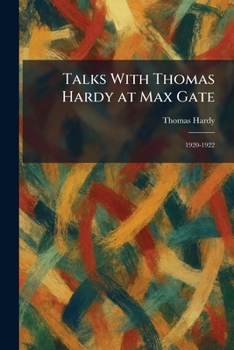
Talks With Thomas Hardy at Max Gate: 1920-1922

"Talks With Thomas Hardy at Max Gate, 1920-1922" offers an intimate and revealing look into the mind of one of England's greatest literary figures during his final years. Set against the backdrop of his beloved home, Max Gate, this work captures a series of personal conversations that took place in the early 1920s. As Thomas Hardy reflects on a lifetime of writing, readers are granted a unique perspective on the motivations and inspirations behind his iconic novels and poetry.
The book explores a wide range of topics, from Hardy's views on contemporary literature and the changing social landscape of post-war Britain to his personal recollections of the Victorian era. These dialogues provide invaluable context for understanding the philosophical underpinnings of his work, revealing a man who remained intellectually vibrant and deeply engaged with the world well into his eighties.
For scholars of English literature and admirers of Hardy's fiction, this collection serves as a vital historical document. It bridges the gap between the public persona of the celebrated author and the private thoughts of a craftsman reflecting on his legacy. Through these candid exchanges, "Talks With Thomas Hardy at Max Gate, 1920-1922" remains an essential resource for anyone seeking to understand the enduring impact of a literary giant.
This work has been selected by scholars as being culturally important, and is part of the knowledge base of civilization as we know it. This work was reproduced from the original artifact, and remains as true to the original work as possible. Therefore, you may see the original copyright references, library stamps (as most of these works have been housed in our most important libraries around the world), and other notations in the work.
This work is in the public domain in the United States of America, and possibly other nations. Within the United States, you may freely copy and distribute this work, as no entity (individual or corporate) has a copyright on the body of the work.
As a reproduction of a historical artifact, this work may contain missing or blurred pages, poor pictures, errant marks, etc. Scholars believe, and we concur, that this work is important enough to be preserved, reproduced, and made generally available to the public. We appreciate your support of the preservation process, and thank you for being an important part of keeping this knowledge alive and relevant.
Customer Reviews
ThriftBooks ® and the ThriftBooks ® logo are registered trademarks of Thrift Books Global, LLC
