


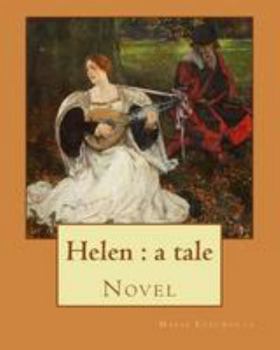
Helen: a tale By: Maria Edgeworth, Novel: Helen is a novel by Maria Edgeworth (1767-1849). It was written in 1834, late in the writer's life.


Select Format
Select Condition 
Book Overview
Helen is a novel by Maria Edgeworth (1767-1849). It was written in 1834, late in the writer's life. Helen tells the story of a young orphan, Helen Stanley, whose guardian, Dean Stanley, has squandered his fortune and left Helen without means of support. She is forced to take up residence with the local vicar, whose wife is astonished that none of the Stanleys' aristocratic friends have offered a refuge to her. Eventually, however, the Davenant family returns from abroad and invite Helen to their daughter's new home, Clarendon Park. (Cecilia Davenant has just married General Clarendon.) Helen journeys to join her dear friend Cecilia (a charming socialite), and the first half of the novel describes Helen's experiences among the most fortunate of Britain's elite under the tutelage of Lady Davenant, who in some ways favors Helen over her own daughter Cecilia. In the second and more dramatic half of the novel, Lady Davenant departs with her husband, who has been named ambassador at the Court of St. Petersburg, Russia. Helen is left to the care of General Clarendon and Cecilia. By this time she is engaged to Granville Beauclerc, a young and handsome man who is another of Lady Davenant's favorites. All does not run smoothly for Helen, however. Before her marriage, Cecilia has carried on an amorous correspondence with Colonel d'Aubigny, a worthless rou who has since died. These letters reappear in a packet addressed to Cecilia's husband. Cecilia implores Helen to act as if the letters were addressed to her rather than to Cecilia. Helen, from misguided devotion to her friend and gratitude for Cecilia's kind hospitality, agrees to the deception. This first step leads to more and more serious consequences, until finally Helen's reputation is in tatters. Beauclerc is forced to fight a duel in defense of his fianc e, after which he must flee from England. Cecilia still refuses to recognize the letters as hers, out of fear of losing her own husband if she admits to the correspondence. The General is convinced that Helen is faithless. She refuses to stay where she is not respected and chooses exile in Wales with the General's sister, where she becomes dangerously ill. Even the birth of Cecilia's first child, a son, does not encourage her to confess to her husband, and Helen gives up all hope of exoneration. The d nouement comes when Lady Davenant, also dangerously ill, returns to London at the same time as the General finally discovers his wife's deception and vows to separate from Cecilia for life. Helen's character is redeemed, Beauclerc returns to England when his adversary recovers from his wounds, and the novel ends happily for all the protagonists with Lady Davenant saying that she is "now, and not till now, happy--perfectly happy in Love and Truth "....... Maria Edgeworth (1 January 1768 - 22 May 1849) was a prolific Anglo-Irish writer of adults' and children's literature. She was one of the first realist writers in children's literature and was a significant figure in the evolution of the novel in Europe. She held advanced views, for a woman of her time, on estate management, politics and education, and corresponded with some of the leading literary and economic writers, including Sir Walter Scott and David Ricardo. Early life: Maria Edgeworth was born at Black Bourton, Oxfordshire. She was the second child of Richard Lovell Edgeworth (who eventually fathered 22 children by four wives) and Anna Maria Edgeworth; Maria was thus an aunt of Francis Ysidro Edgeworth. She spent her early years with her mother's family in England, until her mother's death when Maria was five. When her father married his second wife Honora Sneyd in 1773, she went with him to his estate, Edgeworthstown, in County Longford, Ireland. Maria was sent to Mrs. Lattafi re's school in Derby after Honora fell ill in 1775....
Format:Paperback
Language:English
ISBN:1976509505
ISBN13:9781976509506
Release Date:September 2017
Publisher:Createspace Independent Publishing Platform
Length:282 Pages
Weight:1.40 lbs.
Dimensions:0.6" x 8.0" x 10.0"
Customer Reviews
1 rating
Burney is to Camilla as Edgworth is to Helen
Published by Thriftbooks.com User , 22 years ago
The title of my review may not make sense to readers unfamiliar with the four novels of Frances Burney, nor a bit of biography about the two great women authors, Frances Burney and Maria Edgeworth. Both Burney's Camilla and Edgeworth's Helen are later works of fiction produced after earlier successes. Both were published after a long break in time in writing. Both are perhaps "overworked," and in reading both, I often think of how much anxiety the heroines exhibit, and I sense anxiety in the authors in themselves being expressed in subtle ways in text. Both texts have great strengths, yet if they are read after the greater works of the authors (Evelina, Cecilia, Belinda, Patronage, The Absentee, Ennui), there is a sad sense of lost compactness, lost power. Both Camilla and Helen are longer than they need be, and I suspect their length is the result of excessive rewriting and anxiety on the part of the two authors. Yet having said that, I would argue that second-rate Edgeworth is superior to a great many authors' best efforts. Helen is at heart a story about friendship and betrayal, selflessness and selfishness, social lies and their cost. As usual, once I start to try to narrow down a theme of Edgeworth's, more and more lessons on life and great human issues emerge from her writing. Edgeworth understands people and the social games they play, and this perceptive power is still fresh and relevant in 2004. The role of women in politics, political intrigue, and power is an important theme in the book; here some women will struggle with Edgeworth's ambiguity and long for the absolute world of Mary Wollstonecraft. But Edgeworth tackles issues on a practical level-unlike Wollstonecraft she is not able to say, "This is how it should be," but rather Edgeworth explores issues in social context. She shows us behavior and the diverse reactions of people in society, leads us to look at different values, different lifestyles. There is in all of Edgeworth's novels, a level of common sense and the way of the world that keeps her novels from becoming too didactic, too formulaic, too visionary, and too melodramatic. Just as things seem to become too serious, too moral, or (horrors!) boring, Edgeworth makes us laugh at the silly ways people try to protect or feed their vanity, self-esteem, or social reputation.
Copyright © 2026 Thriftbooks.com Terms of Use
| Privacy Policy | Do Not
Sell/Share My Personal Information | Cookie Policy | Cookie Preferences | Accessibility Statement
ThriftBooks® and the ThriftBooks® logo are registered trademarks of Thrift Books Global, LLC
ThriftBooks® and the ThriftBooks® logo are registered trademarks of Thrift Books Global, LLC
