


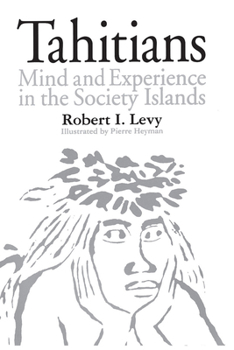
Tahitians: Mind and Experience in the Society Islands


Select Format
Select Condition 
Book Overview
This seminal work in several fields--person-centered anthropology, comparative psychology, and social history--documents the inner life of the Tahitians with sensitivity and insight. At the same time Levy reveals the ways in which private and public worlds interact. Tahitians is an ethnography focused on private but culturally organized behavior resulting in a wealth of material for the understanding of the interaction among historical, cultural, and personal spheres. "This is a unique addition to anthropological literature. . . . No review could substitute for reading it."--Margaret Mead, American Anthropologist
Format:Paperback
Language:English
ISBN:0226476073
ISBN13:9780226476070
Release Date:August 1975
Publisher:University of Chicago Press
Length:576 Pages
Weight:1.76 lbs.
Dimensions:1.2" x 6.0" x 9.2"
Customer Reviews
1 rating
Mind and experience in the South Seas
Published by Thriftbooks.com User , 25 years ago
Robert I. Levy's classic work on Tahitians is an unusual meeting point between traditional ethnographies (broad cultural surveys with everything from gardening charms to system of government) and the more recent wave of psychological ethnographies (sometimes so specific that they discuss little but folk beliefs about the self, or semantic analysis of emotion terms). The combination is refreshing: a trained psychoanalyst and psychiatrist conducts more than two years of fieldwork in a Tahitian village, and gives us not only his insights, but also his data, his process of interpretation, and the sociocultural context in which he worked. Levy's Tahiti was also in a continuing process of Westernization and modernization. Salient contrasts for the islanders were "traditional" versus "demi-European" Tahitians, and both again versus the French government and Chinese merchants. The "traditional" Tahitian culture itself, however, came from the interaction of an older Tahitian culture with Protestant missionaries in the 19th century. Levy draws on the historical and comparative records to present a sympathetic picture of a small society caught in complicated times. Finally, Levy is simply a good writer, and appears to be a good fieldworker as well. He introduces us to nine Tahitians, not all of whom are nice or happy. Through them (in one of the early examples of person-centered anthropology), we glimpse something of what it means to be Tahitian. Levy's presentation is neither romantic nor sentimental, but in reading this book, one understands why the South Seas, and Tahiti in particular, have occupied such a large place in the European imagination. It's a pity there aren't more books like this in the anthropological canon.
Copyright © 2026 Thriftbooks.com Terms of Use
| Privacy Policy | Do Not
Sell/Share My Personal Information | Cookie Policy | Cookie Preferences | Accessibility Statement
ThriftBooks® and the ThriftBooks® logo are registered trademarks of Thrift Books Global, LLC
ThriftBooks® and the ThriftBooks® logo are registered trademarks of Thrift Books Global, LLC
