


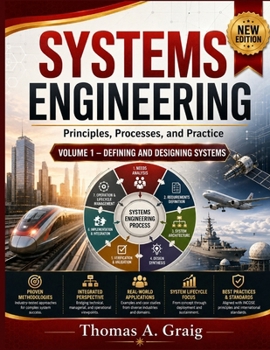
Systems Engineering: Principles, Processes, and Practice
No Customer Reviews

Master the Engineering Discipline That Connects Every Complex System
The world's most expensive engineering failures rarely occur because individual components fail-they happen because entire systems were never engineered to work together.
From aerospace and defense to transportation, energy, healthcare, and industrial automation, today's complex challenges demand more than expertise in a single discipline. They demand the principles, processes, and practical thinking of systems engineering.
Systems Engineering: Principles, Processes, and Practice - Volume 1: Defining and Designing Systems is a comprehensive engineering textbook that provides the knowledge, methods, and analytical tools needed to define problems correctly, develop robust system architectures, and make informed design decisions before costly mistakes occur.
Whether you're an engineering student, practicing engineer, systems architect, technical manager, or researcher, this volume builds a strong foundation in the complete front end of the systems engineering life cycle-from stakeholder analysis and requirements engineering to architecture development, trade studies, Model-Based Systems Engineering (MBSE), SysML, reliability, safety, risk, resilience, and life-cycle cost engineering.
Unlike books that focus only on theory or process, this guide emphasizes practical engineering judgment supported by quantitative analysis, realistic case studies, and proven industry practices. It explains not only what works, but also why common engineering approaches sometimes fail-and how to avoid those costly mistakes before they become real-world problems.
Inside this volume, you'll learn how to:
Define system boundaries and stakeholder needs with confidence
Develop clear, measurable, and traceable engineering requirements
Design logical, functional, and physical system architectures
Perform trade studies and engineering decision analysis
Apply Model-Based Systems Engineering (MBSE) and SysML effectively
Analyze interfaces, reliability, maintainability, safety, and risk
Integrate human factors, resilience, and cyber-physical security into system design
Estimate life-cycle cost and improve long-term system affordability
Designed for both classroom instruction and professional practice, this volume includes 152 fully worked engineering examples, 537 end-of-chapter problems, comprehensive appendices, a detailed glossary, and standards crosswalks that reinforce both conceptual understanding and real-world application.
Whether your work involves aircraft, spacecraft, industrial automation, transportation systems, energy infrastructure, defense programs, medical technologies, or any other multidisciplinary engineering project, the ability to think beyond individual components has never been more valuable.
Great systems are not created by chance-they are engineered through disciplined thinking, sound analysis, and informed decision-making.
If you're ready to design systems that are safer, smarter, more reliable, and built for long-term success, Systems Engineering: Principles, Processes, and Practice - Volume 1 is the essential resource you'll return to throughout your engineering career.
The world's most expensive engineering failures rarely occur because individual components fail-they happen because entire systems were never engineered to work together.
From aerospace and defense to transportation, energy, healthcare, and industrial automation, today's complex challenges demand more than expertise in a single discipline. They demand the principles, processes, and practical thinking of systems engineering.
Systems Engineering: Principles, Processes, and Practice - Volume 1: Defining and Designing Systems is a comprehensive engineering textbook that provides the knowledge, methods, and analytical tools needed to define problems correctly, develop robust system architectures, and make informed design decisions before costly mistakes occur.
Whether you're an engineering student, practicing engineer, systems architect, technical manager, or researcher, this volume builds a strong foundation in the complete front end of the systems engineering life cycle-from stakeholder analysis and requirements engineering to architecture development, trade studies, Model-Based Systems Engineering (MBSE), SysML, reliability, safety, risk, resilience, and life-cycle cost engineering.
Unlike books that focus only on theory or process, this guide emphasizes practical engineering judgment supported by quantitative analysis, realistic case studies, and proven industry practices. It explains not only what works, but also why common engineering approaches sometimes fail-and how to avoid those costly mistakes before they become real-world problems.
Inside this volume, you'll learn how to:
Define system boundaries and stakeholder needs with confidence
Develop clear, measurable, and traceable engineering requirements
Design logical, functional, and physical system architectures
Perform trade studies and engineering decision analysis
Apply Model-Based Systems Engineering (MBSE) and SysML effectively
Analyze interfaces, reliability, maintainability, safety, and risk
Integrate human factors, resilience, and cyber-physical security into system design
Estimate life-cycle cost and improve long-term system affordability
Designed for both classroom instruction and professional practice, this volume includes 152 fully worked engineering examples, 537 end-of-chapter problems, comprehensive appendices, a detailed glossary, and standards crosswalks that reinforce both conceptual understanding and real-world application.
Whether your work involves aircraft, spacecraft, industrial automation, transportation systems, energy infrastructure, defense programs, medical technologies, or any other multidisciplinary engineering project, the ability to think beyond individual components has never been more valuable.
Great systems are not created by chance-they are engineered through disciplined thinking, sound analysis, and informed decision-making.
If you're ready to design systems that are safer, smarter, more reliable, and built for long-term success, Systems Engineering: Principles, Processes, and Practice - Volume 1 is the essential resource you'll return to throughout your engineering career.
Format:Paperback
Language:English
ISBN:B0HCLC8DDT
ISBN13:9798190299335
Release Date:August 2026
Publisher:Independently Published
Length:590 Pages
Weight:2.97 lbs.
Dimensions:1.2" x 8.5" x 11.0"
Customer Reviews
0 rating
Copyright © 2026 Thriftbooks.com
Terms of Use | Privacy Policy | Do Not Sell/Share My Personal Information | Cookie Policy | Cookie Preferences | Accessibility Statement
ThriftBooks ® and the ThriftBooks ® logo are registered trademarks of Thrift Books Global, LLC
ThriftBooks ® and the ThriftBooks ® logo are registered trademarks of Thrift Books Global, LLC
