


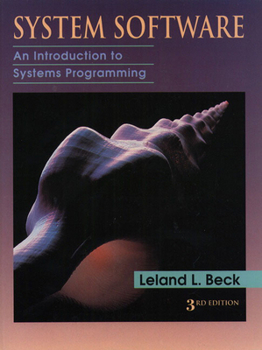
System Software: An Introduction to Systems Programming


Select Format
Select Condition 
Book Overview
In this third edition of classic title, Leland Beck provides a complete introduction to the design and implementation of various types of system software. Stressing the relationship between system software and the architecture of the machine it is designed to support, Beck first presents the fundamental concepts and basic design of each type of software in a machine-independent way. He then discusses both machine-dependent and independent extensions to the basic concepts, and gives examples of the actual system software. New FeaturesProvides updated architecture and software examples, including the Intel x86 family (Pentium, P6, etc.), IBM PowerPC, Sun SPARC, and Cray T3E. Includes an introduction to object-oriented programming and design, and illustrates these concepts of object-oriented languages, compilers, and operating systems. Brings the book up-to-speed with industry by including current operating systems topics, such as multiprocessor, distributed, and client/server systems. Contains a wide selection of examples and exercises, providing teaching support as well as flexibility, allowing you to concentrate on the software and architectures that you want to cover.
Format:Paperback
Language:English
ISBN:0201423006
ISBN13:9780201423006
Release Date:August 1996
Publisher:Pearson
Length:536 Pages
Weight:2.30 lbs.
Dimensions:1.1" x 7.7" x 9.5"
Customer Reviews
3 ratings
The kind of book I've still wanted for a long time
Published by Thriftbooks.com User , 22 years ago
This is a wonderful book help me clear a lot of idea.Most of people study these tools,that is compiler,assembler,OS...and so forth, indenpendently.But L. Beck tell you the relationship between them systematically.It is really worthy of buying the book.It seems that there is hardly books talk about topic such as the content of the book.
The easy path to System Software
Published by Thriftbooks.com User , 24 years ago
After working on C, C++ and a little bit of Assembly languages, you feel excited about the knowledge & underlying mechanisms of assemblers, loaders and linkers etc. I have gone through this book and found it extremely helpful in getting the complex concepts of system softwares. I agree with the idea of author to give the concepts on the basis of a hypothetical machine, rather than going into the complex details of any real system. This provides a big scope of the subject, giving you the ability to feel at ease with any system.What I like most in this book is that, its not so big and with just eight chapters, you feel comfortable about the idea of reading the book. I think, its a must to read book for computer science students.
Pretty Good
Published by Thriftbooks.com User , 25 years ago
I found this book to be a pretty decent guide to understanding basic compilers structures. The reason I give it a four is because it's verbiage was a bit difficult to understand at times. The author begins by using a very novel example of a simple CPU and explains how to write an assembler for it and then a compiler. When you are done reading it you should be able to go off an write a pretty simple assembler, compiler and interpreter. (I did!)
Copyright © 2026 Thriftbooks.com Terms of Use
| Privacy Policy | Do Not
Sell/Share My Personal Information | Cookie Policy | Cookie Preferences | Accessibility Statement
ThriftBooks® and the ThriftBooks® logo are registered trademarks of Thrift Books Global, LLC
ThriftBooks® and the ThriftBooks® logo are registered trademarks of Thrift Books Global, LLC
