


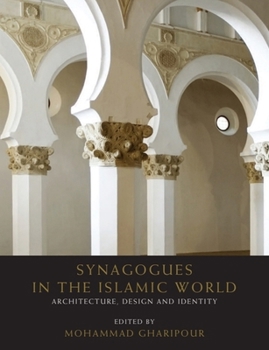
Synagogues in the Islamic World: Architecture, Design and Identity
No Customer Reviews

Explores the design and development of synagogues in the Islamic world
This beautifully illustrated volume looks at the spaces created by and for Jews in areas under the political or religious control of Muslims. Covering regions as diverse as Central Asia, the Middle East, North Africa and Spain, it asks how the architecture of synagogues responded to contextual issues and traditions, and how these contexts influenced the design and evolution of synagogues. As well as revealing how synagogues reflect the culture of the Jewish minority at macro and micro scales, from the city to the interior, the book also considers patterns of the development of synagogues in urban contexts and in connection with urban elements and monuments.
Key Features: Uniquely explores the elements and concepts applied in the design of synagogues in the Islamic world Shows connections between Jewish and Islamic architecture and the collaboration among Muslims and Jews in the design and construction of synagogues Takes an interdisciplinary and cross-cultural approach, providing a new setting for the analysis of Islamic architecture Addresses historical, social, urban, and architectural aspects of synagogues throughout the Muslim world including Iraq, Afghanistan, Morocco, Egypt, Spain, Turkey, Tunisia, Iran, and India Contributors Meltem ?zkan Altın?z, Karab?k University Michelle Huntingford Craig, Getty Research Institute Arlene Dallalfar, Lesley University Reuven Firestone, Hebrew Union College (Los Angeles) and University of Southern California Daniel Mu?oz-Garrido, University of Granada Anat Geva, Texas A&M University Mohammad Gharipour, Morgan State University Ulrike-Christiane Lintz, University of Amsterdam Vivian B. Mann, Jewish Theological Seminary and The Jewish Museum Nesrine Mansour, Texas A&M University Susan Gilson Miller, University of California, Davis Ann Shafer, State University of New York, Fashion Institute of Technology Rabbi M. Mitchell Serels, Berkeley College Jay A. Waronker, Academic and Architect Ethel Sara Wolper, University of New HampshireFormat:Hardcover
Language:English
ISBN:1474411711
ISBN13:9781474411714
Release Date:June 2017
Publisher:Edinburgh University Press
Length:352 Pages
Weight:4.00 lbs.
Dimensions:0.9" x 9.9" x 11.8"
Customer Reviews
0 rating
Copyright © 2026 Thriftbooks.com Terms of Use
| Privacy Policy | Do Not
Sell/Share My Personal Information | Cookie Policy | Cookie Preferences | Accessibility Statement
ThriftBooks® and the ThriftBooks® logo are registered trademarks of Thrift Books Global, LLC
ThriftBooks® and the ThriftBooks® logo are registered trademarks of Thrift Books Global, LLC
