


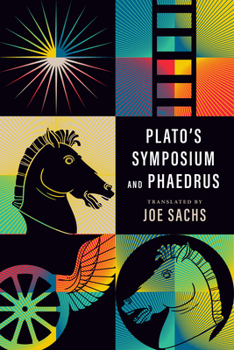
Plato's Symposium and Phaedrus
No Customer Reviews

Select Format
Select Condition 
Book Overview
"Joe Sachs is a national treasure. His brilliant translations from the Greek, spanning works from Homer to Aristotle, have long enriched scholars and students alike. He crowns those achievements with this exquisite rendering of two of Plato's most beautiful dialogues, with an introduction that evidences his deft ability to drill down to 'the thing itself.'"
--Thomas Sheehan, Professor Emeritus of Religious Studies, Stanford University The Phaedrus and Symposium are Plato's two dialogues
about Eros--that is, desirous longing. In these new translations by
former St. John's College tutor Joe Sachs, the reader imaginatively becomes a
member, if a silent one, of the conversations Socrates has with his companions. While both dialogues are about love, they differ in intriguing
and important ways. The conversation of the Phaedrus takes place in the
countryside and that of the Symposium in Athens. In the Phaedrus only
Socrates and Phaedrus are present; in the Symposium many participate in
the drinking party. But in both, Socrates presents singularly abiding images:
The winged horses and chariot in the Phaedrus; the ladder of love in the
Symposium. These compelling images attract and move the reader to ask
questions of the dialogues, which in their unique ways seem to reply. The interplay of the two texts may spark an unfolding in the reader's thinking
about love, but for the dialectical motion that must
occur between the speeches and between the lines of Plato's texts, the reader
must do the work, provoked, invited, and assisted by what they contain. The context for our thinking includes in
one case the subject of tragedy and comedy, in the other the nature of rhetoric
and writing, but it is philosophy, and not poetry or politics, that persistently
claims the center of attention. The dialogues themselves seem as different as
night from day, as urbane wit from rustic charm--but do they point to opposing
or converging attitudes toward erotic love?
--Thomas Sheehan, Professor Emeritus of Religious Studies, Stanford University The Phaedrus and Symposium are Plato's two dialogues
about Eros--that is, desirous longing. In these new translations by
former St. John's College tutor Joe Sachs, the reader imaginatively becomes a
member, if a silent one, of the conversations Socrates has with his companions. While both dialogues are about love, they differ in intriguing
and important ways. The conversation of the Phaedrus takes place in the
countryside and that of the Symposium in Athens. In the Phaedrus only
Socrates and Phaedrus are present; in the Symposium many participate in
the drinking party. But in both, Socrates presents singularly abiding images:
The winged horses and chariot in the Phaedrus; the ladder of love in the
Symposium. These compelling images attract and move the reader to ask
questions of the dialogues, which in their unique ways seem to reply. The interplay of the two texts may spark an unfolding in the reader's thinking
about love, but for the dialectical motion that must
occur between the speeches and between the lines of Plato's texts, the reader
must do the work, provoked, invited, and assisted by what they contain. The context for our thinking includes in
one case the subject of tragedy and comedy, in the other the nature of rhetoric
and writing, but it is philosophy, and not poetry or politics, that persistently
claims the center of attention. The dialogues themselves seem as different as
night from day, as urbane wit from rustic charm--but do they point to opposing
or converging attitudes toward erotic love?
Format:Paperback
Language:English
ISBN:158988177X
ISBN13:9781589881778
Release Date:June 2023
Publisher:Paul Dry Books
Length:194 Pages
Weight:0.65 lbs.
Dimensions:0.7" x 6.0" x 8.9"
Related Subjects
PhilosophyCustomer Reviews
0 rating
Copyright © 2026 Thriftbooks.com
Terms of Use | Privacy Policy | Do Not Sell/Share My Personal Information | Cookie Policy | Cookie Preferences | Accessibility Statement
ThriftBooks ® and the ThriftBooks ® logo are registered trademarks of Thrift Books Global, LLC
ThriftBooks ® and the ThriftBooks ® logo are registered trademarks of Thrift Books Global, LLC
