


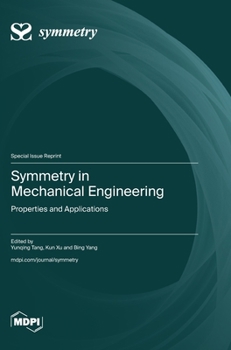
Symmetry in Mechanical Engineering: Properties and Applications

This Special Issue Reprint, titled "Symmetry and Asymmetry in Mechanical Engineering," compiles twelve peer-reviewed articles examining how symmetry and controlled symmetry breaking can be used to improve the performance, reliability, and functionality of mechanical systems. Symmetric configurations remain essential for balanced load transfer, predictable deformation, vibration resistance, and manufacturability, while engineered asymmetry in geometry, material distribution, interfaces, or surface features can enable directional responses, localized enhancement, and specialized thermal or flow behaviors. The Reprint covers a broad range of topics pertaining to mechanical engineering, including the structural mechanics of cracked and graded laminates and sandwich panels, analytical and numerical treatments of plate behavior and nonlinear governing equations, the kinematics and design of symmetric robotic mechanisms, and dynamic modeling, excitation, and failure analysis in high-speed rotors and jointed assemblies. It also features heat dissipation-oriented optimization for air-cooled energy storage cabinets, performance improvement in medical nebulization, microstructural studies of advanced alloys, and a focused review on the subject of surface texture design in tribological applications. Together, these contributions provide an up-to-date overview of symmetry-based design strategies and practical routes for leveraging asymmetry to meet demanding requirements under varied operating conditions.
Customer Reviews
ThriftBooks ® and the ThriftBooks ® logo are registered trademarks of Thrift Books Global, LLC
