


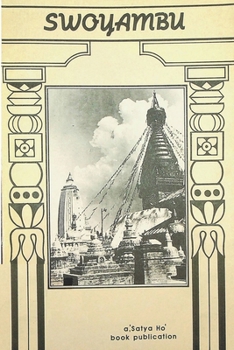
Swoyambu Historical Pictorial

The term Swoyambu (Swayambhū) signifies "self-arisen" or "self-created." The manner in which this designation pertains to the Swoyambu Stupa will, it is hoped, become evident through the present work.
During a residence of three years in Nepal-much of that time spent in close proximity to the stupa-I encountered a wide range of explanations concerning its significance, frequently offered by local guides to visiting foreigners. Many of these interpretations, while well-intentioned, diverged considerably from traditional understandings, a fact not unnoticed by the resident priests, whose responses often conveyed a quiet amusement. Subsequently, and quite unexpectedly, I obtained a recently prepared English summary of an established and authoritative text, The Shree Swoyambu Mahachaitya, composed in Newari by Hemaraj Shakya. The present volume is based upon that work and is offered to readers seeking a more accurate account of the meaning and importance of the Swoyambu Stupa.
The one hundred and thirty-one photographs included herein are intended to serve not only the general visitor but also the serious student of Buddhist thought and practice. Collectively, they document elements of particular significance within the Mahayana Buddhist tradition of Nepal. An effort has been made to present, in visual form, the range of chaityas and sacred images found throughout the twin-peaked hill of Swoyambu.
The organization and careful summarization of the source text-given its linguistic and conceptual complexity-required the expertise of a scholar-priest. I wish to express my sincere gratitude to Mr. Nunche B. Bajracharya, whose methodical and lucid presentation reflects a thorough command of the subject matter.
I am likewise indebted to Mr. Collins Painter, who has directed English departments and teacher-training programs internationally, and who has long been a dedicated student of the Buddhist Dharma. His contribution to the refinement and clarity of this presentation will be readily apparent to the reader.
Customer Reviews
ThriftBooks® and the ThriftBooks® logo are registered trademarks of Thrift Books Global, LLC
