


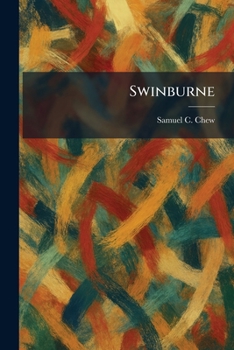
Swinburne

Select Format
Select Condition 
Book Overview
"Swinburne" is a comprehensive critical biography of the celebrated and often controversial Victorian poet Algernon Charles Swinburne. Written by the esteemed scholar Samuel C. Chew, this work provides a meticulous examination of Swinburne's poetic evolution, his revolutionary mastery of meter and rhyme, and his significant impact on late nineteenth-century literature. The study delves into the themes of rebellion, paganism, and political radicalism that defined Swinburne's most famous collections, such as "Poems and Ballads" and "Songs before Sunrise".
Chew offers an insightful analysis of Swinburne's relationship with the Pre-Raphaelite circle and his pivotal role in the Aesthetic movement. Beyond his poetry, the volume explores Swinburne's prolific output as a literary critic and his enduring influence on the English lyric tradition. By situating the poet within his historical and cultural milieu, "Swinburne" serves as an essential resource for understanding the complexities of a writer who challenged the moral and artistic conventions of his age. This critical study remains a vital piece of scholarship for students and enthusiasts of Victorian literature, offering a balanced perspective on one of the most distinctive voices in the English language.
This work has been selected by scholars as being culturally important, and is part of the knowledge base of civilization as we know it. This work was reproduced from the original artifact, and remains as true to the original work as possible. Therefore, you may see the original copyright references, library stamps (as most of these works have been housed in our most important libraries around the world), and other notations in the work.
This work is in the public domain in the United States of America, and possibly other nations. Within the United States, you may freely copy and distribute this work, as no entity (individual or corporate) has a copyright on the body of the work.
As a reproduction of a historical artifact, this work may contain missing or blurred pages, poor pictures, errant marks, etc. Scholars believe, and we concur, that this work is important enough to be preserved, reproduced, and made generally available to the public. We appreciate your support of the preservation process, and thank you for being an important part of keeping this knowledge alive and relevant.
Customer Reviews
ThriftBooks ® and the ThriftBooks ® logo are registered trademarks of Thrift Books Global, LLC
