


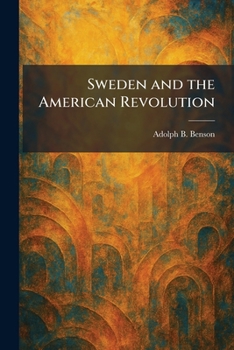
Sweden and the American Revolution

"Sweden and the AMERICAN REVOLUTION" by Adolph B. Benson explores the complex and often overlooked role that Sweden played during the birth of the United States. This scholarly investigation delves into the diplomatic, military, and social connections between the two nations during the late 18th century. Benson meticulously examines the contributions of Swedish officers who served in the American Continental Army and Navy, as well as those who fought under the French flag in support of the American cause.
The narrative goes beyond the battlefield to analyze the political climate of the era, particularly the motivations of King Gustavus III and the strategic importance of the League of Armed Neutrality. By exploring official correspondence, contemporary accounts, and treaty negotiations, the work sheds light on how Sweden became one of the first neutral powers to recognize the independence of the fledgling republic.
Ideal for historians and students of the Revolutionary era, "Sweden and the AMERICAN REVOLUTION" provides a comprehensive look at the international dimensions of the conflict. It highlights the shared ideals and pragmatic interests that forged an enduring bond between a Scandinavian monarchy and a rising democracy. This volume remains an essential resource for understanding the global impact of the American struggle for independence and the specific contributions of Swedish participants.
This work has been selected by scholars as being culturally important, and is part of the knowledge base of civilization as we know it. This work was reproduced from the original artifact, and remains as true to the original work as possible. Therefore, you may see the original copyright references, library stamps (as most of these works have been housed in our most important libraries around the world), and other notations in the work.
This work is in the public domain in the United States of America, and possibly other nations. Within the United States, you may freely copy and distribute this work, as no entity (individual or corporate) has a copyright on the body of the work.
As a reproduction of a historical artifact, this work may contain missing or blurred pages, poor pictures, errant marks, etc. Scholars believe, and we concur, that this work is important enough to be preserved, reproduced, and made generally available to the public. We appreciate your support of the preservation process, and thank you for being an important part of keeping this knowledge alive and relevant.
Customer Reviews
ThriftBooks ® and the ThriftBooks ® logo are registered trademarks of Thrift Books Global, LLC
