


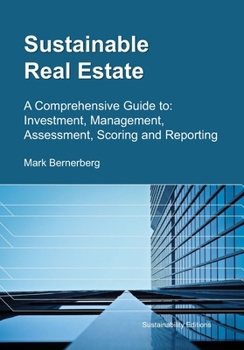
Sustainable Real Estate: Investment & Management

Details
Format: eBook
Copy Protection: No
Pages: 548
File Size: 2.9 MB
Edition: 1st. edition
Language: English
Author: Mark Bernerberg
Targetgroups
All professionals, decision makers, managers, directors, employees, investors and founders in the real estate, construction and finance sectors and also the members of university landscape, policy makers. However, who has interest to understand digital and sustainable transformations in the real estate sectors.
Description:
In an era marked by accelerating urbanization, climate imperatives, and evolving regulatory landscapes, the built environment has emerged as both a challenge and a cornerstone for sustainable development. Sustainable Real Estate: A Comprehensive Guide to Investment, Management, Assessment, Scoring, and Reporting, authored by Mark Bernerberg, provides an indispensable academic and professional resource for real estate stakeholders navigating the complexities of Environmental, Social, and Governance (ESG) compliance and sustainable value creation.
This first edition, published in 2024 as part of the Sustainability Research Editions series, offers a systematic and interdisciplinary examination of sustainability integration in real estate. Drawing from Bernerberg's extensive expertise in finance, legal frameworks, and real estate valuation, the book presents a rigorous, empirically grounded framework for sustainable real estate management, tailored to meet the demands of the European Union's CSRD, CSDDD, and Taxonomy regulations.
The work distinguishes itself through its breadth and analytical depth, spanning 33 comprehensive chapters. It covers key areas such as investment and fund management, sustainability benchmarking, portfolio strategy, life cycle cost analysis, digital transformation, and ESG reporting. Each chapter not only explores conceptual underpinnings but also provides practical methodologies, case studies, and real-world application tools designed to guide professionals in implementing best practices across the property lifecycle.
Bernerberg introduces advanced evaluation models-such as sustainability scoring systems and automated valuation techniques-alongside detailed discussions on data analytics, IoT, BIM, and AI as enablers of smart, transparent, and efficient real estate management platforms. These technological integrations are presented not as ancillary tools but as central to achieving sustainability targets at the asset, portfolio, and institutional levels.
Importantly, the book situates sustainable real estate within a broader socio-economic and ecological context, emphasizing its role in fostering resilient, inclusive urban communities and contributing to global climate objectives. In doing so, it addresses not only the financial imperatives of sustainability but also its social and ethical dimensions, offering a triple-bottom-line approach that resonates with both corporate strategists and public policy advocates.
Designed for a multidisciplinary audience-including investors, asset managers, sustainability officers, property developers, and policymakers-Sustainable Real Estate stands as a landmark publication. It bridges the gap between regulatory obligations and strategic opportunity, equipping readers with the tools to operationalize sustainability in real estate while aligning with long-term value creation.
In summary, Bernerberg's contribution is more than a textbook; it is a roadmap for the real estate industry's transition toward a decarbonized, data-driven, and ethically grounded future. It is an essential reference for anyone seeking to understand or influence the future of sustainable property investment and governance.
Customer Reviews
ThriftBooks® and the ThriftBooks® logo are registered trademarks of Thrift Books Global, LLC
