


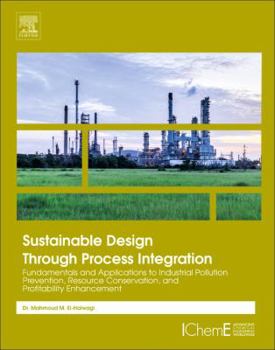
Sustainable Design Through Process Integration: Fundamentals and Applications to Industrial Pollution Prevention, Resource Conservation, and Profitabi

Select Format
Select Condition 
Book Overview
Sustainable Design through Process Integration: Fundamentals and Applications to Industrial Pollution Prevention, Resource Conservation, and Profitability Enhancement, Second Edition, is an important textbook that provides authoritative, comprehensive, and easy-to-follow coverage of the fundamental concepts and practical techniques on the use of process integration to maximize the efficiency and sustainability of industrial processes. The book is ideal for adoption in process design and sustainability courses. It is also a valuable guidebook to process, chemical, and environmental engineers who need to improve the design, operation, performance, and sustainability of industrial plants. The book covers pressing and high growth topics, including benchmarking process performance, identifying root causes of problems and opportunities for improvement, designing integrated solutions, enhancing profitability, conserving natural resources, and preventing pollution. Written by one of the world's foremost authorities on integrated process design and sustainability, the new edition contains new chapters and updated materials on various aspects of process integration and sustainable design. The new edition is also packed with numerous new examples and industrial applications.
Format:Paperback
Language:English
ISBN:0128098236
ISBN13:9780128098233
Release Date:August 2017
Publisher:Elsevier
Length:618 Pages
Weight:3.70 lbs.
Dimensions:1.2" x 8.5" x 10.8"
Customer Reviews
1 rating
Oh no, it’s a textbook.
Published by bernie4444 , 5 days ago
The projects and concepts are very generic. However, instead of treating this book as separate from the real world, it can help define what you already know. I have worked with chem-milling, anodizing, annealing, and the like for quite some time (the stories I could tell you). I only learned what I needed when I needed it. Now I find that the how-to is a science, and I also see that there is an attempt to integrate “sustainable design”.
The diagrams and formulas are easy to follow. They clarify those murky areas of the process where you know what you are doing but cannot explain it to others. However, I am not too sure that the economic aspects are realistic. As with any textbook, you can extract what you can use without bogging down the system by trying to do everything with the book. On the positive side, the book can help with planning instead of haphazardly experimenting with processes.
Still, after reading this book, I see that there are a few practices that could use some review.
Hopefully, in the future, this book will have a companion or support website where the diagrams can be downloaded, and questions can be asked of the author.
Copyright © 2026 Thriftbooks.com Terms of Use
| Privacy Policy | Do Not
Sell/Share My Personal Information | Cookie Policy | Cookie Preferences | Accessibility Statement
ThriftBooks® and the ThriftBooks® logo are registered trademarks of Thrift Books Global, LLC
ThriftBooks® and the ThriftBooks® logo are registered trademarks of Thrift Books Global, LLC
