


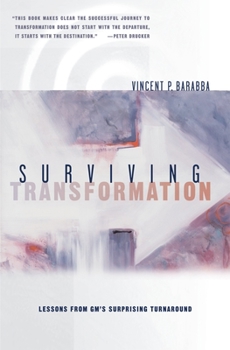
Surviving Transformation: Lessons from GM's Surprising Turnaround

How did a major corporation manage to turn itself around while Wall Street and others continued to predict its slow death? The answer may surprise you, and it provides a model for corporate transformation for any company or government agency operating in a world of accelerating change. The company is General Motors, and this book tells how it was able to change the way important decisions were made, leading to resurgence in business across its many product lines. At the beginning of the 1990s, GM was perceived by nearly everyone as falling behind its competitors at an alarming rate. By the beginning of the twenty-first century, though, the company had come storming back with successful new automobiles and new business concepts that captured new markets, while simultaneously holding on to many of its existing customers. What GM did is not just the story of a single automaker, but rather a compelling insight into an approach for any business organization that is faced with the need for a true transformation. As many companies have discovered, efforts at transformation too often fail. GM's successful transformation illustrates the importance of management's ability to change its mindset and make the tough decisions that revitalize business with bold new products and business concepts. At the heart of successful transformation is the imagination, courage and leadership required to visualize the kind of company an organization wants to become and then work toward that goal. With the destination set and understood by those who will need to implement the changes, decision-makers find it less difficult to overcome impediments to achieving their goal while finding creative ways of doing what may seem impossible. The lessons from GMs turnaround can help any business organization change and keep pace with today's turbulent marketplace.
Format:Hardcover
Language:English
ISBN:0195171411
ISBN13:9780195171419
Release Date:August 2004
Publisher:Oxford University Press
Length:280 Pages
Weight:1.20 lbs.
Dimensions:0.8" x 6.0" x 9.0"
Customer Reviews
5 ratings
Combining Theory and Practice
Published by Thriftbooks.com User , 21 years ago
Most case studies on organization transformation simply tell what was planned and what happened, sprinkling in a little theory here and there, but generally as an afterthought. Vince Barabba's book on "Surviving Transformation" offers something different, a well-composed blend of theory and practice. The author enjoys two advantages. First, he was instrumental as a senior executive in designing and orchestrating the changes that occurred at GM. Second, he has a sound background in the "systems approach to change." Combining the two,the author has been able to offer the inside story of the redesign of one of the world's largest corporations while, at the same time, framing it in a conceptual context that helps us to understand exactly why it succeeded. Finally, Vince Barabba offers a model for change that is not unique to his company' situation, but can be used by a wide range of other organizations. I recommend the book highly to those who understand the need for on-going organization learning and adaptability.
Knowing we can create the future is key!
Published by Thriftbooks.com User , 21 years ago
If you only focus on just one thing from this book, you will get tremendous benefit. I am referring to coming to term with the core concept that the future is something your company can influence...can create for the benefit of both itself and its customers. Taken to it maximum opportunity-generating dimension, this philosophy can lead business leaders to what is, in my humble opinion, the future of business leadership...for corporate leaders to help redesign all of society so that it adapts - in a healthy and constructive way - to the global challenges all corporations face today.
Great insights into buisness approach
Published by Thriftbooks.com User , 21 years ago
I was frustrated with the business book that claimed to have THE answer however as I read them they did not fit my circumstances - ever! Surviving Transformation is the first book that gave me a toolkit to understand and apply to many business challenges. The great insight provided by Mr. Barabba is that multiple business models not only can but most likely should exist within one company. Rather than presenting one answer for success in the future, I got an understanding of three types of businesses that must be mixed according to a market and company's characteristics. There are ample great examples to help you understand the drivers behind each model. I think it is also great that Mr. Barabba uses General Motors as his test bed. I always thought of GM as stodgy and lagging the "high tech" companies as far as business approaches. I now understand that GM's business approach is highly sophisticated and actually a better model for most companies facing increasing market challenges. Also, I really enjoyed the discussion on the "zone of discomfort" where a business must face the reality of being a leader in an underperforming or declining industry. I have been in many of those meetings and I now have some perspective on the solution. I would highly recommend Surviving Transformation to expand your awareness of the variables to consider when formulating your business strategy.
Business Models & Organizational Transformation
Published by Thriftbooks.com User , 21 years ago
There is no dearth of business models, as are the books about them. Some models promise the world, others show the ways to salvation, almost always without any practical case to substantiate the claims. If there is any story to tell, it is almost, always a second hand account. Fortunately, some books are far more refreshing than these ordinary runs of the mills books. Here is one such book worth reading. Based on his participation and study from the automobile industry, specifically GM, Vince Barabba presents a compelling case for the business models, particularly the model of anticipate and lead. It tells the story of how GM was on the verge of bankruptcy pulled its acts together and emerge as the corporation to contend with, all in a few years. Few key features of this book, that would set it apart from its counterparts, are systems thinking approach, emphasis on process and transparency, author's participation in the decision making process, and a view (albeit brief) into risk management issues. The personal involvement and experience of the narrator makes it a practice management book. With copious details that would help students prepare business cases, this book would also have relevance in academia.
On Transformation
Published by Thriftbooks.com User , 21 years ago
Former GM executive Vince Barabba's latest book provides a fascinating example of organizational transformation - namely, GM's turnaround between 1992 and 2003 - and identifies strategic business designs that can benefit any enterprise's strategy development process. The story is an interesting one, indeed, but even more interesting is the mindset behind the example - that is, the systems thinking approach to creative problem-solving, which can apply to organizations and individuals alike. Acknowledging the pioneering contributions of avant-garde thinkers Peter Drucker and Russell Ackoff, Barabba shares his personal transformation from business school model-builder to creative visionary. Among the systems thinking principles discussed are respect for the complex nature of problems; management of the whole rather than the parts; flexibility regarding change; and knowledge acquisition through experience, especially through mistakes. For Barabba, the learning process is as important as the outcome, and enterprises facing difficult times are better poised to see opportunities in changing the way things are done. By combining imagination and market knowledge, Barabba's experiences can benefit us all.
Copyright © 2025 Thriftbooks.com
Terms of Use | Privacy Policy | Do Not Sell/Share My Personal Information | Cookie Policy | Cookie Preferences | Accessibility Statement
ThriftBooks ® and the ThriftBooks ® logo are registered trademarks of Thrift Books Global, LLC
ThriftBooks ® and the ThriftBooks ® logo are registered trademarks of Thrift Books Global, LLC
