


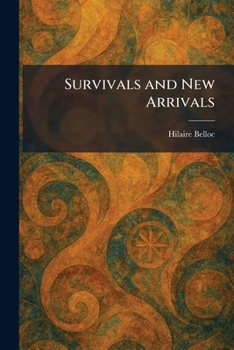
Survivals and New Arrivals

"Survivals and New Arrivals" is a masterful examination of the Catholic Church's position in the early 20th century, written by the prolific historian and essayist Hilaire Belloc. In this insightful work, Belloc analyzes the various intellectual and social forces arrayed against the Faith, categorizing them into those that are fading (the "Survivals"), those that are currently at their peak, and those that are just beginning to emerge (the "New Arrivals").
Belloc explores a wide range of topics, including the remnants of the Reformation, the rise of scientific materialism, and the challenges posed by new political and philosophical movements. With his characteristic clarity and conviction, Belloc provides a roadmap for understanding the shifting cultural landscape and the enduring resilience of Catholic doctrine. This volume serves as both a historical snapshot of a world in transition and a timeless piece of Christian apologetics. It offers readers a profound look at how ancient truths encounter and respond to the spirit of the modern age, making it essential reading for those interested in religious history, sociology, and the intersection of faith and public life.
This work has been selected by scholars as being culturally important, and is part of the knowledge base of civilization as we know it. This work was reproduced from the original artifact, and remains as true to the original work as possible. Therefore, you may see the original copyright references, library stamps (as most of these works have been housed in our most important libraries around the world), and other notations in the work.
This work is in the public domain in the United States of America, and possibly other nations. Within the United States, you may freely copy and distribute this work, as no entity (individual or corporate) has a copyright on the body of the work.
As a reproduction of a historical artifact, this work may contain missing or blurred pages, poor pictures, errant marks, etc. Scholars believe, and we concur, that this work is important enough to be preserved, reproduced, and made generally available to the public. We appreciate your support of the preservation process, and thank you for being an important part of keeping this knowledge alive and relevant.
Customer Reviews
ThriftBooks ® and the ThriftBooks ® logo are registered trademarks of Thrift Books Global, LLC
