


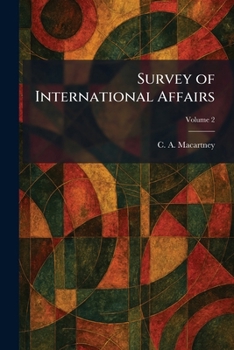
Survey of International Affairs

"Survey of International Affairs 1925" Volume 2, authored by C.A. Macartney, provides an exhaustive and scholarly examination of the geopolitical landscape during a pivotal year of the interwar period. This volume meticulously documents the shifting alliances, diplomatic negotiations, and regional conflicts that defined international relations in the mid-1920s.
The work offers detailed insights into the challenges faced by the League of Nations and the evolving political dynamics across Europe, Asia, and the Americas. By analyzing treaties, state interactions, and the socio-economic factors influencing foreign policy, Macartney provides a comprehensive overview of the era's quest for stability and the underlying tensions that would shape the twentieth century.
Ideal for historians, students of political science, and those interested in diplomatic history, this survey serves as a vital primary source for understanding the complexities of world order following the First World War. It remains a significant contribution to the study of international affairs, capturing the nuances of a world in transition through rigorous academic research and historical synthesis.
This work has been selected by scholars as being culturally important, and is part of the knowledge base of civilization as we know it. This work was reproduced from the original artifact, and remains as true to the original work as possible. Therefore, you may see the original copyright references, library stamps (as most of these works have been housed in our most important libraries around the world), and other notations in the work.
This work is in the public domain in the United States of America, and possibly other nations. Within the United States, you may freely copy and distribute this work, as no entity (individual or corporate) has a copyright on the body of the work.
As a reproduction of a historical artifact, this work may contain missing or blurred pages, poor pictures, errant marks, etc. Scholars believe, and we concur, that this work is important enough to be preserved, reproduced, and made generally available to the public. We appreciate your support of the preservation process, and thank you for being an important part of keeping this knowledge alive and relevant.
Customer Reviews
ThriftBooks ® and the ThriftBooks ® logo are registered trademarks of Thrift Books Global, LLC
