


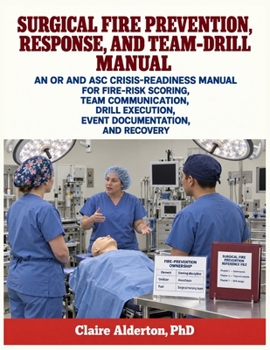
Surgical Fire Prevention, Response, and Team-Drill Manual: An OR and ASC Crisis-Readiness Manual for Fire-Risk Scoring, Team Communication, Drill Exec
No Customer Reviews

The Exposure Inside a Familiar Operating Room An operating room can appear ready while the coordination that controls fire risk remains untested. Oxygen may be present near the field, an ignition source may be activated, and fuel may be available in prep solution, drapes, sponges, or other materials. If each discipline understands its own task but no one closes the loop across the fire triangle, a routine case can carry a high-consequence gap that an annual module or signed roster does not reveal. Why General Awareness Is Not a Readiness System Surgical fire prevention crosses anesthesia, surgery, nursing, sterile practice, equipment use, education, risk, and quality. A generic warning does not establish who scores the case, which words are spoken during the time-out, how oxidizer and ignition-source plans are reconciled, what changes for facial or airway procedures, or how the team responds when a drill exposes hesitation. This manual connects those duties inside one governed operating framework. Build the Case-Level Control Architecture Start with program ownership, procedure-specific risk scoring, and escalation rules that identify when enhanced controls are required. Use completed fire-risk cards and stronger time-out language to make the risk visible before activation. Coordinate oxidizer management, prep and drying confirmation, draping and fuel control, and the handoff that precedes energy-device use. Role clarity turns separate precautions into a shared decision trail the whole team can follow. Prepare for the Cases with the Narrowest Margin Apply the framework to facial, airway, pediatric, oxygen-enriched, and other elevated-risk fields where proximity and access can change the response. Position-specific prompts help teams confirm equipment, communication, and contingency expectations without pretending that one script fits every patient or procedure. The manual repeatedly defers device choices, patient-specific actions, and emergency decisions to current instructions, approved policy, fire-code requirements, and qualified professionals. Turn Drills into Observable Team Performance Design scenarios around credible local failure points, assign observers, and score communication, role execution, equipment access, sequence, and recovery. Role cards and immediate-response algorithms make expectations explicit before the drill begins. Debrief prompts separate individual hesitation from system defects such as unclear ownership, inaccessible equipment, inconsistent language, or incomplete orientation. Remediation and repeat-drill logs preserve what changed and whether the change was verified. Document the Event and Close the Learning Loop When a fire, near miss, or drill finding occurs, capture the timeline, fire-triangle conditions, actions, equipment, communications, patient assessment, notifications, and evidence needed for review. Root-cause tools connect findings to named corrective actions, owners, due dates, and effectiveness checks. Recovery and support steps sit beside operational repair, while dashboards and annual reviews help leaders see recurring weak points rather than treating every event as an isolated story. Move from Annual Education to Maintained Readiness Designed for OR and ASC nursing, anesthesia, surgical-services, education, quality, and risk leaders, this manual provides completed scoring cards, scripts, drill scenarios, observer rubrics, documentation tools, and update controls that facilities can adapt through their own approval process. It is an independent educational resource, not clinical or legal advice, and it does not guarantee fire prevention, injury avoidance, accreditation, or liability protection. Its purpose is to make surgical-fire readiness governed, rehearsed, documented, and reviewable.
Format:Paperback
Language:English
ISBN:B0HFFCS1DF
ISBN13:9798192922866
Release Date:August 2026
Publisher:Independently Published
Length:226 Pages
Weight:1.18 lbs.
Dimensions:0.5" x 8.5" x 11.0"
Customer Reviews
0 rating
Copyright © 2026 Thriftbooks.com
Terms of Use | Privacy Policy | Do Not Sell/Share My Personal Information | Cookie Notice | Cookie Preferences | Accessibility Statement
ThriftBooks ® and the ThriftBooks ® logo are registered trademarks of Thrift Books Global, LLC
ThriftBooks ® and the ThriftBooks ® logo are registered trademarks of Thrift Books Global, LLC
