


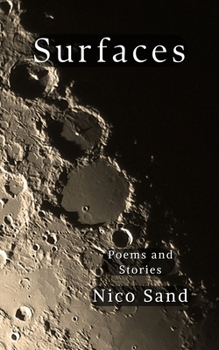
Surfaces: Poems and Stories
No Customer Reviews

"Surfaces" is a collection of poems and stories about language and its consummate manifestation, reason. In it, language becomes both subject and medium-an intricate mirror reflecting humanity's vociferous struggle within the silent equilibrium of nature. These works invite readers to explore the tension between human conceptuality-the highly utility-oriented imagining of the objects, actions and ideas-and nature's indifferent yet harmonious existence.
Through lyrical device and philosophical imagery, the author delves into the inextricable relationships between language and reason, reason and morality, morality and progress, progress and happiness, and between happiness and the unhappy reality that human advancement has been accompanied by a reduction in the scope and prominence of nature, as well as a taming of the "animal" passions and instincts that connect us to the natural environment. As a result, we are losing not only a portion our "selves," but we are depleting the earth and depriving many living species the freedom, beauty, vitality and natural continuance that is their primordial heritage. This book offers contemplative enjoyment for readers who value depth, abstraction and philosophical resonance, perfect for those drawn to the intersection of literature, linguistics and ethics. These works are not interested in what is good and evil, but why. They are concerned with surfaces, the delineations that create, separate and define the many concepts that make up our world and the predispositions by which these things are conceived. They are the building blocks of reality as we speak, think and know it. To some we are drawn and to others we are repulsed, but the meaning derived from their interaction, if rational, will be conducive to judgement. And the consequence of judgement is the incentivization to act. It is a scheme that parallels the basic nervous system, which induces action directly from sensory input. But these two systems do not always agree and thus, the moral dilemma. To which side should we concede authority? And why? Can we trust the veracity of a patently self-serving conceptuality over the feelings of our primal senses? And if so, by what rational criteria? Is math the only arbiter of right and wrong? What is the secret agenda of language? What hidden syllogism lies at the base of all argument? These are the problems that are probed in these pages. The object is not to solve, but to explore, question, provoke and entertain. Styles vary and the subject matter is diverse, but the central theme is consistent-the inseparable relationship between reason and morality and the possible evolutionary glitch portended by that association.Format:Paperback
Language:English
ISBN:B0GXSRJTHH
ISBN13:9798898985509
Release Date:April 2026
Publisher:Jgkirby
Length:108 Pages
Weight:0.25 lbs.
Dimensions:0.3" x 5.0" x 8.0"
Customer Reviews
0 rating
Copyright © 2026 Thriftbooks.com
Terms of Use | Privacy Policy | Do Not Sell/Share My Personal Information | Cookie Policy | Cookie Preferences | Accessibility Statement
ThriftBooks ® and the ThriftBooks ® logo are registered trademarks of Thrift Books Global, LLC
ThriftBooks ® and the ThriftBooks ® logo are registered trademarks of Thrift Books Global, LLC
